[Amar Sangno]
The All Arunachal Pradesh Students’ Union (AAPSU) has always been a beacon of hope for the common people in raising public or students’ welfare-oriented issues since its inception. The AAPSU has always played the role of opposition, especially when no opposition leaders dare to challenge the ruling government on issues of the state’s interest.
The respect that the apex students’ organisation commands across the social and political spectrum is because of the supreme sacrifice and sheer dedication of the founding members and years of struggle and determination by various leaders in defending the state’s indigenous rights.
“During the 1980s and 1990s, leaders were selected or elected purely on merit and leadership qualities. In many cases, presidents and general secretaries were invited and unanimously chosen to lead the organisation. The last president to be selected unopposed was Nabam Jallow during the Miao Conference in 1997. That period reflected unity, discipline, and genuine student leadership,” said Pritam Waii Sonam, coordinator of the NESO.
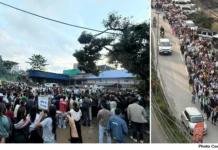
Given the recent AAPSU election-related violence during the electoral registration process at the NEFA building, Itanagar, where four people reportedly sustained injuries and two people were allegedly seen wielding arms, have deeply shaken the conscience of genuine students who have a genuine concern for the state’s future. More importantly, it has sparked debate across the social spectrum about the future of the AAPSU and students’ politics in the state.
Has AAPSU lost its spark?
It’s an open secret that the AAPSU election is no longer the normal student’s election it used to be in the ’90s and the early 2000s. In recent times, the increasing role of money in the electoral process has become endemic to the system.
Of course, the most inconvenient questions that often crop up are:
Where does this much money come from? Who’s funding these candidates? Are genuine students really selling their future for a few bucks?
Sadly, these questions have never got answers, whereas everyone is already aware of the truth. Needless to say, it’s unlikely that the state’s intelligence agency is unaware of this money flow; even a daily wage earner knows that presidential and general secretary candidates spend nearly Rs 15-20 crores to get elected.
It has become a business opportunity for a few students whose only objective is to enrol themselves in some lesser-known courses, so that they can earn a hefty amount from AAPSU candidates.
It’s said that, from semester admission fees to paying house rents, new iPhone models to scooter purchases, the candidates have to pay to get vote. Sometimes, all candidates pay the same voter; nobody knows whom that voter will vote for.
“The excessive role of money began after the 2009 AAPSU election, when the per-voter payment system was sneakily introduced. This unhealthy practice opened the door for the ruling government to indirectly interfere in student politics. Unfortunately, this system continues even today,” Sonam claimed.
It’s certain that once a candidate has spent so much money, even if they get elected, they’ll drift away from their fundamental objective.
Another obvious factor contributing to the AAPSU’s waning as an institution is its archaic and arcane electoral process. Often, the election commission, whose responsibility is to conduct free and fair election, have a tacit understanding with a particular candidate, which leads to poll-related violence.
Former AAPSU president Tage Lapung believes that the core problem lies in the deliberate exclusion of an age limit from the AAPSU’s constitution. “Can we even imagine a person over 40 years old stinking in a student organisation?” Lapung said.
“Second most disturbing factor is the state political operators and their leadership playing the role of vendors, to either amplify or mute the voice of organisation leaders” Lapung said.
What could be the reformative steps?
If the AAPSU is to reform its electoral process, one popular demand is setting an age limit for the candidates. The All Assam Students’ Union (AASU) has already set a retirement age of 40 for student politics. Many opined that limiting voter lists is also one of major reasons behind the increase in unaccounted money flow.
The Supreme Court held that the recommendations made by the Justice JM Lyngdoh Committee shall be binding on universities and colleges in India. The AAPSU, being a non-registered organisation, is an exception to this case.
“One of the most effective reforms would be to restrict candidature to bachelor’s students only. Almost all premier student organisations in the Northeast follow this system, but the AAPSU remains an exception. If the bachelor-only system is adopted, an automatic age limitation will come into force, bringing discipline and accountability,” Pritam Waii Sonam opined.
“From college first semester to university, all recognised universities across the India should be made eligible to vote. The larger the student voters’ size, the lesser the chances of spending money,” said a student on condition of anonymity.
As the apex students’ organisation’s election process begins, growing concern among citizens is poll-related violence. Unless bold reforms are initiated, the AAPSU risks losing its credibility and core values as a true students’ organisation. Let’s wait and watch whether AAPSU would change its spots.