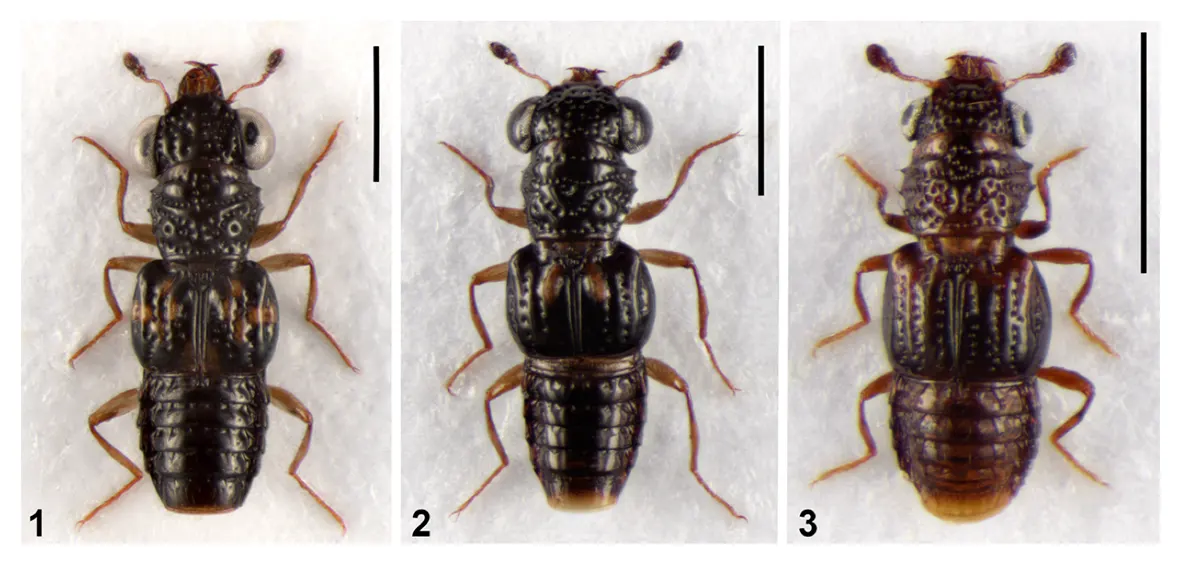
RONO HILLS, 2 Apr: A team of researchers from Rajiv Gandhi University (RGU), in collaboration with the University of Tübingen, Germany, has discovered three species of rove beetles new to science.
The species Megalopinusarunachalensis, Megalopinusmithun, and Megalopinus micros, were documented by researchers Tobias Mainda, Hiren Gogoi, Tagam Dobiam, Sonu Singh, and Oliver Betz during an expedition in Arunachal Pradesh from December 2024 to March 2025. It was initiated and led by Prof Dr Oliver Betz of the University of Tübingen, Germany, and hosted by Dr Hiren Gogoi from RGU.
In addition to the new species, the study also reported new regional records of Megalopinushelferi and Megalopinusnepalensis. Their findings were recently published in the journal Soil Organisms, highlighting the rich but underexplored insect diversity of Northeast India.
The newly discovered beetles belong to the genus Megalopinus, a group of small rove beetles typically found in moist forest habitats such as decaying wood and fungal leaf litter. Among the three, Megalopinus micros is notable for being one of the smallest species in the genus, measuring only about 1.9 mm in length. The species epithet ‘arunachalensis’ refers to Arunachal, ‘mithun’ refers to the semi-domesticated cattle Bos frontalis, locally known as mithun in Arunachal, and the ‘micros’ refers to the exceptionally small size.
The specimens were collected from the Eaglenest Wildlife Sanctuary, the Pakke Tiger Reserve, Mechukha valley, and the Aalo forest division. The researchers used methods such as sifting moist leaf litter and examining decaying logs to uncover these hidden insects.
The study underlines the importance of conserving forest microhabitats, such as decaying wood and leaf litter, which support a wide range of lesser-known organisms.
The research was supported by a grant from the German Research Foundation, and was conducted under a formal collaboration between RGU and the University of Tübingen. The study received necessary approvals from the National Biodiversity Authority of India and Arunachal’s environment, forest & climate change department.
The researchers acknowledged the vital support of local communities and mountain tribes of Arunachal, whose cooperation and traditional knowledge played an important role in the success of the fieldwork.