Tribal Bookworms
[ Dr Bompi Riba ]
After a period of quiet hibernation, I find myself returning to this space to discuss a book which was described by its poet as an anatomy of the soul. This book has intrigued my interest mainly because of the excessive pessimistic emotional register and made me wonder how little we truly understand the ways people think, feel and process their lived experiences.
Perhaps it is from this position of unease that I express my curiosity towards the tendency among young writers to gravitate towards pessimistic emotional landscapes in their writings.
Though I might sound superstitious, personally, I believe that words have the power to manifest reality and maybe that explains why I am resistant, though unintentionally, to writings that dwell inordinately in despairing emotions.
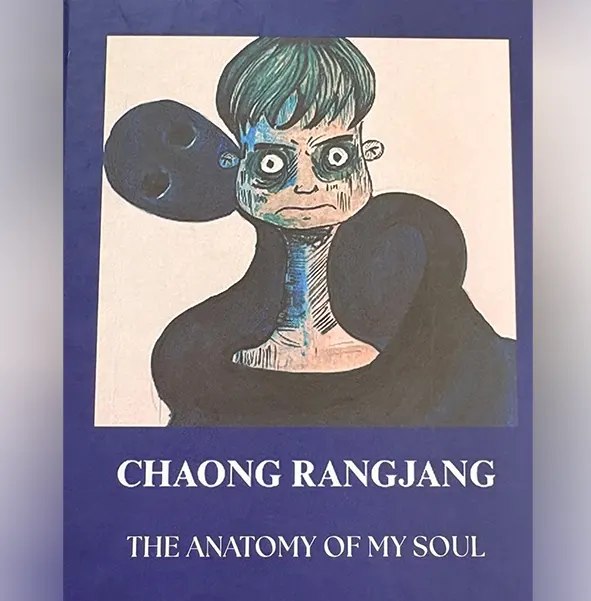
However, it is important to note that this reflection is in no way meant to dismiss the legitimacy of the depth of such emotions. Rather, it is an attempt to understand that sensibility closely. It is from this place of curiosity, and not judgement that I approach this book, The Anatomy of My Soul by Chaong Rangjang.
This collection exhibits features of confessional poetry, particularly, in terms of its emotional intensity, but it does not explicitly reveal private details or inner conflicts and offers a more restrained and implied vulnerability. The poems largely explore existential despair and they are predominantly expressed in a melancholic and bitter tone, which is further intensified by the surreal illustrations that reflect the complexities of the human mind.
It is also worth noting that the word ‘anatomy’ in the title is traditionally used to refer to dissection, most often of the human body. Here, the meaning changes mainly because of its focus, which shifts from the tangible ‘body’ to the intangible ‘soul’. Ironically, the soul cannot be dissected. Therefore, what the poet is attempting to suggest is more abstract, like the mapping of the human experience itself. Despite the promising title, the poet’s execution remains limited and the collection falls short of its potential by focusing largely on existential despair and overlooking the broader spectrum of human experiences that shape the soul.
The first poem of the collection, titled ‘Dawn’, sets the mood for the subsequent poems that explore the themes of existential crisis and despair. It grapples with relatable existential concerns such as the fear of growing up, rejection, and being out of place. However, the speaker’s image remains somewhat indistinct. But it does feel that he is an adult regressing into a childlike state and his vulnerability is suggested through the repeated address to his mother, who is like an anchor of safety for him. The poem comes across as an early draft of a potentially powerful piece that is emotionally loaded and yet it falls short in achieving its fullest effect.
As a reader, one also feels that the emotional intents of the subsequent poems are not fully realised. For illustration, one can refer to the poem titled, ‘Change’, which is structured in two stanzas. While the first stanza appears to be a request to the speaker to change his personality, behaviour and appearance, the second stanza seems to be a response to that appeal. But this response seems more reactive than organic. Had the first stanza been framed more clearly as an imposition, the reaction in the second stanza would seem more natural because it does come across as plain rebellion against advices. In addition to that, the repetitive use of words and phrases in these poems generate a sense of redundancy, which contribute towards diluting their overall impact, which is further aggravated by the presence of a few noticeable grammatical errors that cannot be overlooked.
Notwithstanding the abovementioned limitations, the second part of the collection, under the section ‘Genesis’, is particularly compelling. Personally, I found this section more engaging because of its use of rich imagery and experimentation. For instance, the month ‘April’ in India is usually sought after for its blooming flowers, mild weather and festivals, but the poet refers to it as “the month of melancholy,” echoing TS Eliot’s famous line, “April is the cruellest month.” In Arunachal Pradesh, the seasonal overlapping, from late winter to spring to pre-monsoon, can be altogether felt in the month of April. Therefore, it seems as if the external transition in the seasonal mood had succeeded in generating an internal sense of uncertainty, chaos and instability in the poet. She talks about chasing the wind endlessly, which symbolically refers to something tangible, that one can feel but never quite get hold of, such as truth, purpose, or meaning of life. Then she alludes to the decisive moment of breaking the chain of familial and societal expectations, but leaves no further insight. Consequently, the reader is left without much clarity about the specificity of her claimed freedom.
In the next poem, she uses ‘the caterpillar’ as the central metaphor for the state of pre-transformation, which further hints towards the sense of being in the threshold where one experiences a sense of identity crisis. She repetitively uses the word ‘crawling’ to evoke a sense of stagnation, monotony and fatigue, which further alludes to the underlying anxiety that comes with the realisation of her untaped potentialities. She also uses bodily sensations to express emotional distress and address her anxiety of feeling out of place. The ending of the poem is interesting because of the use of an ambiguous imagery, where the tiny crack in the cocoon could mean an opening, suggesting the metamorphosis of the caterpillar into a butterfly. But if the crack happens to be a fracture, then there may be a rupture in the delicate structure of the cocoon. This could potentially damage the chrysalis, which in turn may lead to the emerging of a butterfly with underdeveloped or distorted wings. This imagery is actually very powerful as it hints towards the speaker’s own sense of fractured identity as she continues to struggle with unrealised possibilities in her life.
It is interesting to note that there are some poems in the collection that do not have any titles. Usually, the title of a poem gives a context to the readers, but the poet deliberately leaves the poems untitled to reinforce the idea of being in a moment that is neither fixed nor defined. Though personally I wouldn’t recommend such practice, it seems more like an experiment and surprisingly, it fits the mood of the poet’s drifting and uncertain overthinking. Without the title, the readers feel as if they are dropped straight into the mind of the poet, which is in a state of mental loop; thus, mirroring the general mood of the collection.
There are some touching moments in the poems where the poet, feeling dejected, expresses her need for some love to survive a little longer. She also uses the phone booth as a metaphor to convey a sense of profound loneliness and the desperate need for someone to hear her out. One can only imagine the sense of being stuck in a situation of utter helplessness, where the soul is crying out for help but the phone booth, which is the only medium of connection, fails to do its service. The collection also consists of some heart-wrenching poems such as the untitled, ‘I am alive but I feel like a dead man’, ‘Canvas’, ‘Cloud’, ‘Something like home’ and ‘The noisy town’. These poems come across as raw but they express the poet’s sentiments with startling sincerity and they also manage to provoke a sense of sorrow among the readers.
Overall, the poems in the collection are engaging. They would have benefitted more from careful editing. If the grammatical lapses and overuse of repetition of phrases and words were avoided, the work could have achieved more clarity and impact. Nevertheless, as a debut writer, Chaong Rangjang has demonstrated genuine potentiality and she will grow in depth and range if she continues to write and explores broad themes. Given that this collection focuses chiefly on existential despair, it seems fitting to end with a reflection on existential dissatisfaction from the film Passengers, where an android butler observes, “You are not where you want to be. You feel like you are supposed to be somewhere else. Say you could snap your fingers and be wherever you wanted to be, I bet you’d still feel this way – not in the right place. The point is, you can’t get so hung up on where you’d rather be that you forget how to make the most of where you are. So, take a break from worrying about what you can’t control. Live a little”. A thought worth pondering. (Dr Bompi Riba is assistant professor in the English department of RGU, and a member of the APLS and Din Din Club)