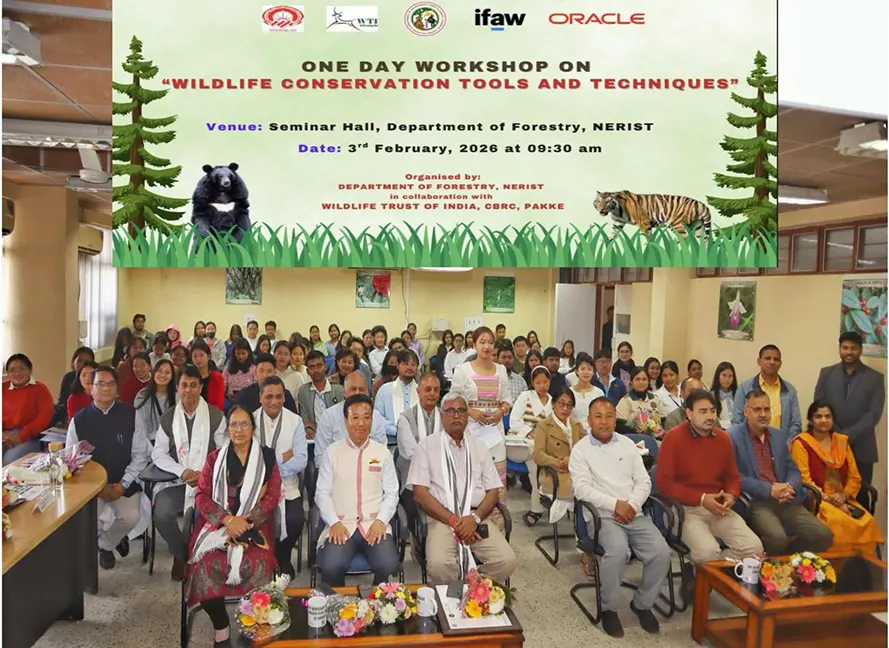
NIRJULI, 3 Feb: The forestry department of the North Eastern Regional Institute of Science and Technology (NERIST), in collaboration with the Wildlife Trust of India (WTI) and the Arunachal Pradesh forest department, organised a workshop titled ‘Wildlife conservation tools and technology’ at the NERIST on Tuesday.
More than 100 conservation scientists, researchers, academicians, and students participated in the programme which focused on advancing practical strategies for wildlife protection in the eastern Himalayan region.
Addressing the inaugural session, NERIST Director Prof Narendranath S highlighted the urgent need to integrate modern technology with field-based conservation practices. He emphasised that academic institutions like the NERIST must play a proactive role in producing skilled professionals to address emerging challenges, including habitat fragmentation, wildlife crime, and the impacts of climate change on biodiversity.
NERIST Dean (R&D) Prof MB Sharma in his address underscored the importance of research-driven conservation and interdisciplinary collaboration. She encouraged students and young researchers to actively engage in applied research and field-based solutions for sustainable wildlife management.
Conservator of Forests Millo Tasser shared field-based insights, emphasising the importance of community participation, traditional ecological knowledge, fundamental duties of citizens, and robust institutional support for effective conservation outcomes in Arunachal.
NERIST Forestry Department Head Prof Awadhesh Kumar, Dr Ashish Paul from the NERIST, and Dr Panjit Basumatary from the WTI spoke on the importance of wildlife and end-user relationship.
The technical sessions featured eminent resource persons from premier conservation and research institutions of Northeast India, who shared practical tools, methodologies and case studies in wildlife conservation and management.
Guwahati (Assam)-based Pygmy Hog Conservation Programme’s project director Dr Parag Jyoti Dekadelivered a presentation on species recovery programmes and conservation breeding techniques, while Dr Prabal Sarkar from USTM, Meghalaya, delivered a presentation on wildlife monitoring, data collection tools, and field technologies on primate conservation.
Tezpur University’s Environmental Science Professor Ashalata Devi gave a presentation on plant sampling techniques, community-based conservation, and wildlife habitat assessment.
Dr Monsoon J Gogoi from ATREE gave a presentation on butterfly diversity and conservation in Arunachal, and Zoological Survey of India, Itanagar APRC Scientist B Dr Vikram Delu delivered a presentation on the use of wildlife forensic and tricho-taxonomy in wildlife crime control.
WTI ecologist Dr Subhasish Arandhara delivered a presentation on the rehabilitation ecology of the Asiatic black bear at CBRC, Pakke Tiger Reserve.
The workshop addressed modern wildlife conservation tools and technologies, such as wildlife monitoring techniques, camera trapping, biodiversity documentation, conservation breeding, community-based conservation models, and the role of research institutions in supporting forest department.
Faculty members, research scholars, and students from NERIST, Rajiv Gandhi University, the ZSI, and the National Forensic Science University-Goa campus participated in interactive sessions and discussions, gaining practical exposure to current conservation practices relevant to Arunachal and the wider Northeast region.