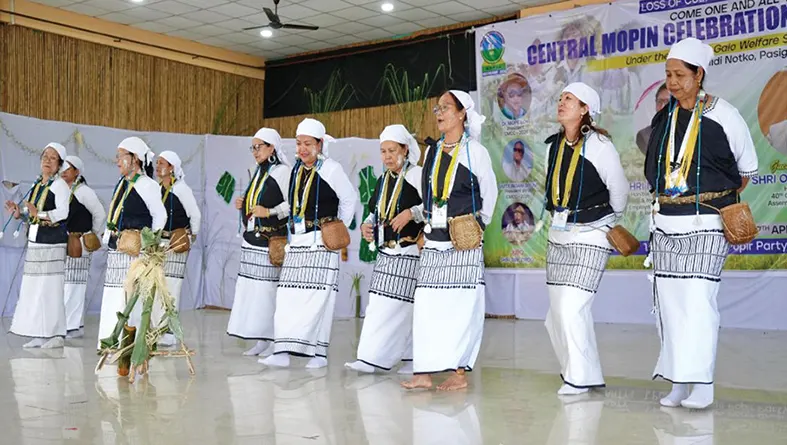
ITANAGAR, 5 Apr: Mopin was celebrated across the state by the Galo community, showcasing its vibrant culture, traditions and spirit.
Participating in the festival in Namsai on Sunday, Chief Minister Pema Khandu lauded the members of the community for preserving their rich traditions, culture, and faith.
“Heartfelt thanks to our Galo elders and youths for carrying forward the indigenous Galo traditions,” Khandu wrote on his social media handle on X.
He said that it was inspiring to see the coming together of different tribes, reflecting unity in diversity “and the strength of our shared heritage.”
“May our traditions continue to thrive for generations to come,” the chief minister said.
“Mopin is not just a festival; it is a celebration of culture and traditions, nature, and community. Rooted in the reverence for Mopin-Digo Ane, the mother goddess, it symbolises prosperity, protection, and harmony for all living beings,” Deputy Chief Minister Chowna Mein wrote on his social media handle.
He said that this year’s theme, ‘Unity in diversity’, truly reflects the essence of Namsai, where different communities come together as one family.
“The participation of our Tai Khamti and Singpho brothers and sisters highlights the deep-rooted harmony that defines our land,” he said.
On the occasion, Mein remembered late CP Namchoom, who started the celebration of Mopin in Namsai in the late 1970s, laying the foundation of unity and shared cultural pride.
Praising the rich cultural heritage of the community, Mein said: “From the graceful Popir dance to the sacred chants of the nyibus, every moment reflects our rich heritage and timeless traditions.”
“Let us continue to preserve our culture, strengthen our unity, and celebrate our diversity with pride,” he said.
The festival was attended by a host of ministers and MLAs.
In Likabali in Lower Siang district, the festival was celebrated centrally at Gensi.
Attending the festival, Education Minister PD Sona said that festivals should serve as a medium to reconnect with cultural roots, rather than merely being occasions of celebration.
He appealed to the festival committees to promote unity and inclusiveness by inviting community-based organisations instead of political figures to foster stronger harmony among communities.
Highlighting recent reforms in the education sector, he noted that the Education Act would ensure equitable distribution of manpower and significantly improve the education scenario in the state. He stressed that professional commitment must complement infrastructure development.
On the occasion, the minister inaugurated the newly constructed government higher secondary school in Gensi building and interacted with teachers and members of the school management committee, emphasising the importance of quality education in rural areas.
He assured that, in addition to the PMGSY scheme, the government will further expand rural road connectivity under the Chief Minister Gramin Sadak Yojana, especially for areas not covered due to population criteria.
He also expressed satisfaction over improved connectivity, appreciating the PMGSY road leading to Gensi.
During the day, six RCC bridges along the Garu-Sibe route, constructed by the rural works department, were also inaugurated.
Deputy Speaker Kardo Nyigyor stressed the need to prioritise more developmental projects under the PMGSY, including the sanctioning of a school auditorium and a girls’ hostel. He also encouraged promoting self-reliance during festival celebrations.
Deputy Commissioner Gobi Nyicyor also spoke.
The programme witnessed enthusiastic participation of officials, community leaders, teachers, and members of the public, marking a significant milestone in the development of infrastructure and education in Lower Siang district.
In Pasighat in East Siang district, the festival was celebrated with traditional fervour and gaiety.
The Mopin festival was celebrated under the leadership CMCC-26 president Dr Mope Loyi, CMCC general secretary Jompa Kakki, and team CMCC.
Addressing on the festive occasion, minister Nyato Dukam said that “we share a common heritage and cultural thread in essence” and advocated “transmitting our rich folklores and mythology to the younger generation.”
The minister commended the organising committee for its dedicated efforts in upholding the rich cultural values.
“Our community festivals like Mopin have agricultural-based origin, marking the beginning of the agricultural cycle linked to our agragrian traditions,” Dukam added.
MLA Oni Panyang urged the youths to take forward their heritage with a sense of great responsibility and sense of duty towards community and society.
Narration of the Mopin mythology, a community feast,popwr pognam, and cultural presentations were the highlights of the Mopin celebration.
The festival was attended by, among others, MLAs Ninong Ering and Tapi Darang, PMC Chief Councillor Tagom Padung and his deputy Kamin Lego, councillors, BBYK president Magyar Lego, and tourists.
In Khonsa in Tirap district, the members of the community residing in Tirap district celebrated Mopin with great enthusiasm.
Tirap Deputy Commissioner Techu Aran described the Galo community as one of the most progressive and vibrant communities in Arunachal Pradesh. He said that many other tribes and communities could learn from the rich culture and traditions of the Galos.
He praised the community for preserving and promoting their ancestral culture.
Dr Tumli Basar narrated the mythology associated with Mopin, and stated that it is an agricultural festival of the Galo community, during which goddess Anyi-Pinku Pinte is worshipped for a bumper paddy harvest, peace, and prosperity throughout the year.
He said that Mopin Giidi is the main festival of the Galo community, with deep mythological roots and is generally celebrated on 5 April across Galo-inhabited districts in a grand manner.
The day’s events included traditional dance performances by various artists from Khonsa, which were enthusiastically enjoyed by the guests and attendees, who also participated in the performances. (With inputs from DIPROs)