ITANAGAR, 8 Jan: Reacting to the BJP’s renaming the Mahatma Gandhi National Rural Employment Guarantee Scheme (MGNREGA) as Vikshit Bharat-Guarantee for Rozgar and Ajeevika Mission (Gramin) or VB-G RAM G Act, the Arunachal Pradesh Congress Committee (APCC) on Thursday sought immediate restoration of MGNREGA.
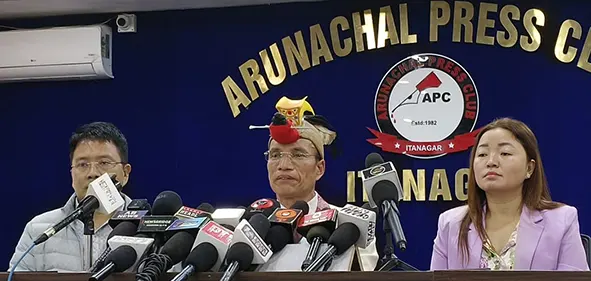
APCC spokesperson Gyamar Tana, addressing reporters at the press club here said that the Congress would launch ‘MGNREGA Bachao Sangram’ to oppose the renaming.
He said that the MGNREGA was the lifeline of India’s workers for 20 years and more than 180 crore days of work have been generated since its implementation in 2006.
Tana claimed that earlier, under the MGNREGA, work had to be provided within 15 days.
“However, under the current BJP government, the work will no longer be a right but instead an easy way to grab votes by luring the public through schemes,” he said.
He claimed that the Modi government would pick and choose which gram panchayat would be allowed to avail of work.
Tana said that, under the MGNREGA, “work was provided at notified minimum wages, which were increased for 12 months.” However now, under the BJP government’s VB-G RAM G “wages will be set with no guaranteed minimum for 10 months with absence of yearly revisions,” he said.
He also alleged that “the present government is handing over the power of gram panchayats to contractors,” and alleged that the gram panchayats would lose their authority and “become only an implementing agency.”
“Contractors will be brought in and workers will be diverted into becoming labour supply for the contractor’s project,” Tana said.
The state Congress demanded guarantee in work, wages, and accountability. It also sought complete restoration of the “constitutional right to work” and establishment of the national minimum wage of Rs 400 per day (as promised in the election manifesto of the Congress in 2024), as the BJP is providing Rs 241 per day.
It said that, under the VB-G RAM G, unemployment may rise, labourers might be exploited without payment of minimum wages, distress migration might increase, and the panchayati raj might lose power, authority, and relevance.