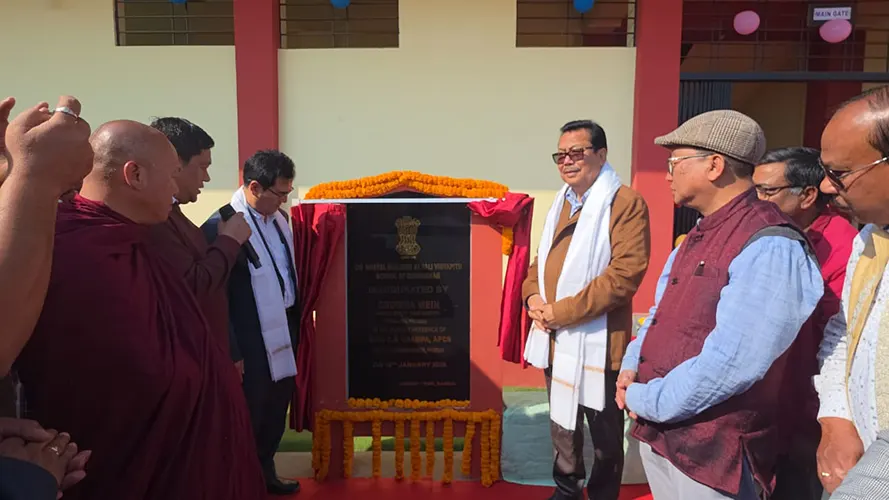
CHONGKHAM, 15 Jan: Deputy Chief Minister Chowna Mein on Thursday reiterated the government’s commitment to education, heritage conservation, and community development, and urged all stakeholders, including the local administration and community leaders, to extend continued support to the Pali Vidyapeeth here in Namsai district.
The DCM said this after inaugurating the newly constructed 60-bedded hostel building of the Pali Vidyapeeth, and commended the institution for promoting education, cultural harmony, and inclusive learning.
Congratulating the Pali Vidyapeeth Society and the construction agency for timely completion of the hostel, Mein acknowledged the growing demand for boarding facilities in the region, and gave assurance that the government would explore further expansion of hostel infrastructure.
Highlighting the historical journey of the Pali Vidyapeeth, the deputy chief minister recalled the contributions of earlier leaders and monks who helped establish the institution and secure infrastructure support through central and state assistance. He reaffirmed the government’s continued support through annual grants-in-aid and infrastructure funding.
He informed that in previous years, the state government had sanctioned funds for internal roads, drainage systems, guest house facilities, and academic support, and assured that assistance would continue in line with institution’s needs.
Emphasising the importance of preserving linguistic and cultural heritage, Mein stressed the need to strengthen teaching of Pali language and local scripts, particularly the Tai Khamti script, and encouraged the institution to include local language education as part of its academic curriculum.
He also called for working towards digitisation and restoration of rare manuscripts housed in the institution’s museum. “Experts will be engaged to document, digitise, and restore the manuscripts to preserve them for future generations,” Mein said.
The programme was attended also by DC CR Khampa, ADC K Tikhak, RWD SE Tanga Kena, government officials, public leaders, executive members of the institution’s management committee, teachers, students, and members of the local community. (DCM’s PR Cell)