Staff Reporter
ITANAGAR, 10 Mar: This year’s winners for the five best suggestions under the jan bhagidari (people’s participation) initiative submitted ideas on topics ranging from tourism and environment to governance and artificial intelligence.
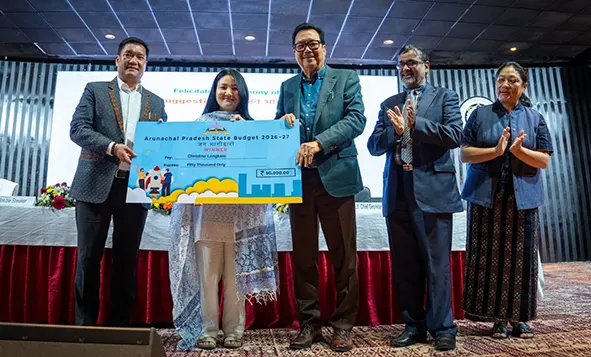
All five winners were felicitated on Tuesday at the state Legislative Assembly during the ongoing budget session. Chief Minister Pema Khandu and Deputy Chief Minister Chowna Mein handed over the awards to the winners.
Under the jan bhagidari, citizens submit ideas and suggestions for the state budget.
Christina Langkam, a student, won the first prize for her suggestion on unlocking the state’s tourism potential. She proposed the issuance of a ‘gold seal’ certification for homestays, under which they would be rated as gold, silver, or bronze, based on their hygiene standards and hospitality, assessed through routine inspections.
Sonjoy Bagang suggested a strategic plan to transform the state’s extensive forest cover (over 80 percent) into a ‘sovereign carbon economy’ that could generate direct revenue for tribal communities. The proposal aims to monetise the state’s natural capital by connecting local communities to global carbon markets.
Lakhi Mena in his suggestion called for the establishment of ‘community harmony centres’ (CHCs) across all districts to promote social integration, peaceful conflict resolution, and youth engagement. The initiative aims to strengthen unity, preserve traditional wisdom, and guide youths towards constructive development.
Milli Bharat in his suggestion titled ‘Arunachal secure’ proposed the development of a next-generation digital inner line permit (d-ILP) ecosystem. The proposal addresses the urgent need for a closed-loop monitoring system for inner line permits (ILP) by leveraging AI-powered facial recognition for exit tracking and blockchain technology for labour permit verification. The system aims to ensure enhanced internal security while simultaneously boosting the indigenous homestay economy through a ‘digital concierge’ integrated into the ILP app. The project is designed to be self-sustaining, generating annual revenue through a nominal digital infrastructure cess, thus requiring no long-term financial burden on the state.
Bangkong Perme in his submission focusing on strengthening civic sense proposed a system-based reform approach to address urban decay and behavioural gaps in the state, particularly in Itanagar. The proposal outlines a three-pillar strategy for improvement: infrastructure strengthening, enforcement mechanisms, and education and public participation.