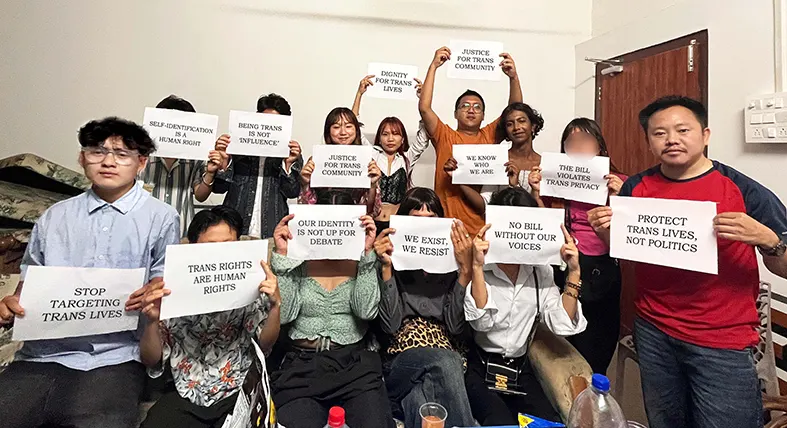
PAPU NALLAH, 26 Apr: The AP QueerStation has expressed serious concern over how the Transgender Persons (Amendment) Bill 2026 has already begun affecting the transgender community in Arunachal Pradesh.
During a meeting convened here on Saturday, several transgender members shared distressing experiences at district administrative offices, where they reported being dismissed, humiliated, and denied services. These incidents were attributed to both the anticipated implementation of the bill and a lack of awareness and sensitivity among officials towards transgender individuals.
The meeting also addressed ongoing legal petitions currently before the Supreme Court and different high courts. The members explored the possibility of pursuing similar legal action from Arunachal.
AP QueerStation’s legal adviser, Ebo Milli, participated in the meeting and advised the community on potential legal remedies. He emphasised the importance of filing a petition, and provided guidance on the procedures involved in approaching the high court.
Sawang Wangchha, a queer-trans activist, highlighted the “disproportionate burden the bill places on economically vulnerable transgender individuals, particularly those from rural and low-income urban communities.” He emphasised that removing self-identification and enforcing medical or administrative proof would result in increased travel, medical interventions, financial hardship, and procedural barriers – “realities that are simply not feasible for many community members from underprivileged backgrounds, especially in the villages of Arunachal.”
Concerns were also raised regarding the violation of the fundamental right to privacy under Article 21 of the Constitution of India. The members argued that compelling individuals to undergo verification processes undermines dignity, autonomy, and personal liberty, and reflects an unjust and exploitative approach.
Additionally, the inclusion of vague terms such as ‘alluring’ in the bill was strongly criticised. The members expressed concern that such language could be misused by transphobic individuals, including family members, to falsely accuse or target those providing safe spaces and support to the community, especially at a time when cases of family violence, discrimination, and social exclusion are on the rise.
The community also raised serious concern over the absence of recognition for indigenous and regional gender identities such as mumbar, mumbal, etc. Members noted that the bill is narrowly framed around north Indian socio-cultural categories like hijra, kinnar, and aravani, effectively overlooking and erasing the diverse identities of the Northeast and other regions. “Alarmingly, trans men are not mentioned anywhere in the bill, reinforcing their invisibility and deepening fear and uncertainty within the community,” the AP QueerStation stated in a release.
It strongly condemned the bill, describing it as exclusionary, regressive, and harmful to the transgender community. The collective reiterated its commitment to safeguarding the rights, dignity, and wellbeing of transgender individuals, and affirmed its resolve to continue resisting policies that undermine constitutional values and human rights.