[ Prem Chetry ]
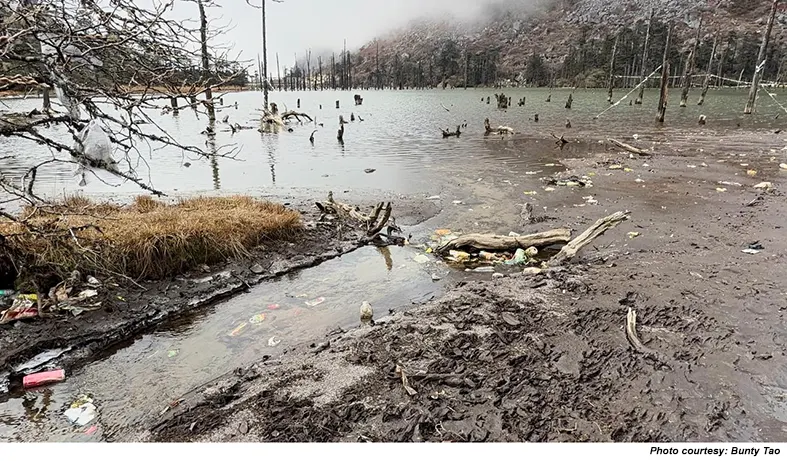
TAWANG, 30 Dec: Incessant deposition of silt and littering at Sangetsar Tso – one of the high-altitude lakes, located at 12,165 feet, and an important habitat for many rare migratory birds – in Tawang district calls for immediate attention and designation of the lake as a Ramsar site, conservationists have said.
Wakro (Lohit)-based Kamlang Tiger Reserve Range Forest Officer Bunty Tao, who is also the president of the Ranger Federation of Asia and a member of the International Ranger Federation, said that active siltation would destroy the lake due to sediment deposits and other non-degradable elements. He added that microorganisms, which form the primary food source for these birds, would be damaged.
“Ruddy shelduck is a high-altitude resident bird, and its breeding lake is something very special. Conservation of this lake is essential for maintaining ecological balance,” he said. He added that this wetland should be recognised by Wetlands International and the lake can be proposed to be designated as a Ramsar site as India is a signatory to the Ramsar Convention.
Sangetsar Tso is a wetland that deserves to be designated as a Ramsar site of international importance under the Ramsar Convention on Wetlands (1971). At present, Glaw Lake in Lohit district has been proposed as a Ramsar site, and the proposal is under active consideration.
During his recent visit, Tao expressed concern over the increasing siltation and accumulation of garbage in and around Sangetsar Tso. He remarked that “we may not see the lake after 10 years, as silt deposits are building up rapidly due to extensive earth-cutting activities being carried out by the BRTF and the Army, although these are part of the country’s strategic requirements.”
However, he noted that a meticulous mitigation plan and expert intervention could help retain the lake’s biological significance.
Meanwhile, conservationist and birding guide Lobsang Tsering said that most lakes in Tawang district, including Sangetsar Tso, are important winter destinations and breeding grounds for many migratory birds, including the ruddy shelduck, the white-throated dipper, the white-throated redstart, the white-winged redstart, and the goldcrest.
Tsering called upon local tour operators, guides, and taxi drivers to encourage visitors and tourists not to litter these ecologically sensitive areas.
“Tawang is a paradise for migratory birds, and if we fail to take responsibility for maintaining the ecological balance of these lakes, migratory birds may stop coming here in the future,” he said.
At present, there are no silt-protection measures around the lake to contain siltation. Moreover, reckless littering from restaurants and by visitors and tourists is accelerating the degradation of the lake.
“Unless an urgent mitigation plan is put in place to save this lake, we may lose one of the most beautiful wetlands of Arunachal Pradesh,” Tao said.
He said that development should go hand in hand with conservation. “Mitigation measures in all development schemes and proper waste disposal systems should be prioritised,” he added.