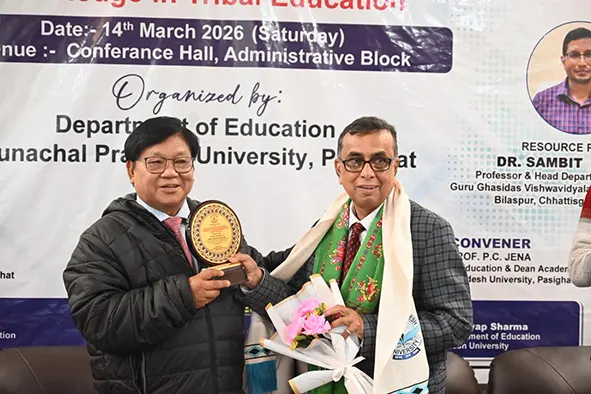
PASIGHAT, 14 Mar: Tribal communities are knowledge holders and living repositories of wisdom that the world is only now beginning to recognise, said former Arunachal Pradesh University (APU) vice-chancellor Prof Tomo Riba, addressing a national seminar on ‘Culturally responsive pedagogy: Integrating indigenous knowledge in tribal education’, organised by the APU’s education department here in East Siang district on Saturday.
“Our forefathers were great people and they held tremendous knowledge – knowledge that is helping the world today,” Prof Riba said, urging educators and policymakers to ensure that this heritage finds its rightful place within the formal education system.
He spoke on the importance of traditional institutions such as the Nyibu Nyegam Yarko and the Menjwk Meqkok Rwguu (MMR) Gurukul in Basar, saying these institutions have for generations transmitted not merely information but an entire philosophy of life rooted in harmony with nature, respect for elders, and community responsibility. He described them as living models of indigenous education whose value must not be underestimated.
On the question of language, Prof Riba said that, while an earlier generation took pride in children who could speak Hindi or English, the time has come to reverse that thinking. “We must take pride in speaking our native language,” he said, expressing concern that many young people today no longer know the language their grandparents spoke.
He noted that tribal knowledge systems – from medicinal plant use and sustainable farming to ecological conservation – are increasingly being validated by modern science worldwide. He encouraged the department to continue organising seminars that engage with tribal knowledge and its relevance to contemporary education.
Former RGU pro-vice-chancellor Prof Amitava Mitra spoke on higher education as a catalyst for economic growth in Arunachal Pradesh.
Drawing on his years of experience working in the state, Prof Mitra said that Arunachal has changed considerably before his eyes – from a time when higher education institutions were few and far between, and students had to travel great distances or leave the state entirely to pursue a degree, to today, when universities, colleges, and research institutions have begun to take firm root across the region.
“The transformation has been visible and real,” he said, “but the potential that still lies untapped is far greater than what has been achieved so far.”
Prof Mitra said that Arunachal occupies a unique position in the country – a state of extraordinary biodiversity, cultural plurality, and strategic importance, sitting at the crossroads of South and Southeast Asia. He argued that this uniqueness, rather than being a challenge, is the state’s single greatest educational and economic asset. “The knowledge that lives in the forests, the villages, the oral traditions of this land – no university in the plains can replicate or manufacture that,” he said. “Arunachal’s higher education system must learn to mine that wealth.”
He contended that for too long, higher education in the Northeast has measured itself against templates designed for the mainland – producing graduates trained for a job market and a social context that does not always match the ground reality of their home state. The result, he observed, has been a steady outflow of educated young people who leave and do not return, leaving communities without the human capital they need to grow. “We educate our youths and then lose them,” he said. “That is not development. That is drain.”
He pointed to the enormous economic potential in areas such as ecotourism, organic agriculture, traditional medicine, handicrafts, and sustainable forestry – all sectors in which Arunachal holds a natural advantage, and all sectors that require an educated, culturally aware workforce to realise their full potential. “The hills, the rivers, the forests, the festivals, the languages – these are not obstacles to development. They are the development,” he said.
Guru Ghasidas Vishwavidyalaya Education HoD Prof Sambit Kumar Padhi stressed that a sound curriculum must precede any meaningful discussion of pedagogy.
“Curriculum plays a very crucial role,” he said. “Before we decide how to teach, we must first be certain about what we are teaching and why.” He emphasised that teachers must look carefully at the specific needs of each student and design their instruction accordingly, rather than delivering uniform content to a diverse classroom. A curriculum built without sensitivity to the learner’s social, cultural, and linguistic background, he argued, would always fall short, no matter how skilled the teacher delivering it.
Prof Padhi noted that in tribal educational contexts, this gap between curriculum and lived experience is particularly acute. Students arrive in classrooms carrying a wealth of knowledge inherited from their communities – knowledge of the land, of plants, of seasons, of stories – and yet the curriculum often has no space for any of it. “When a child sees no connection between what is taught in school and what is valued at home,” he said, “we should not be surprised when that child disengages.”
He called for curriculum designers and educational planners to engage directly with tribal communities in the process of developing learning materials, so that the curriculum reflects rather than erases the world the child comes from.
Prof Padhi returned at length to the National Education Policy 2020, which he described as perhaps the most significant structural opportunity for tribal education reform in independent India. He said NEP 2020’s emphasis on mother tongue-based multilingual education, flexible curriculum frameworks, and the recognition of local knowledge systems is not incidental, but reflects a fundamental rethinking of what Indian education is for and whom it must serve. “NEP gives us the policy space that educators in tribal regions have been waiting for,” he said. “Now the responsibility lies with institutions, teachers, and communities to use that space wisely and urgently.”
Earlier, APU Education HoD Dr PC Jena set out the academic vision behind the seminar with clarity and conviction.
He said that the department chose the theme not merely because it is topical, but because it speaks to a fundamental crisis in Indian education – the systematic exclusion of indigenous knowledge from the spaces where knowledge is officially produced, validated, and transmitted.
“We have built an education system that is vast and expanding,” he said, “but we must ask honestly whether it is truly inclusive – whether it speaks to the child who grows up in a tribal village, in a language the school does not recognise, with knowledge the textbook does not acknowledge.”
Dr Jena observed that tribal communities across India are custodians of knowledge systems that have sustained ecosystems, resolved social conflicts, preserved biodiversity, and shaped cultural identities across generations – yet these systems are largely absent from formal curricula. He said this absence is not merely an academic oversight; it carries real consequences for learners, who are asked to abandon their cultural identity at the school gate in exchange for an education that may feel foreign and irrelevant. “Education that alienates the learner from their own roots does not liberate,” he said. “It diminishes.”
He expressed hope that the seminar would serve as more than a forum for papers and presentations – that it would become a genuine space for reflection, debate, and the building of collaborative academic commitments. He called on scholars, researchers, and educators present to carry the insights of the day back into their classrooms, their curricula, and their institutions, and to work towards an education system that draws strength from the diversity of India’s cultural landscape rather than flattening it.
The seminar drew participation from institutions, including the Central University of Himachal Pradesh, NIEPA (Odisha), Jamia Millia Islamia, Dibrugarh University, Burdwan University, Utkal University, KR Mangalam University, Patna University, Gurukul Kangri University, Rajiv Gandhi University, Arunachal University of Studies, and several colleges from across Arunachal and India.
Approximately 38 research papers were presented across parallel technical sessions conducted in hybrid mode.
The offline sessions, chaired by Dr Eli Doye and Dr Fames Linggi, covered themes including teachers’ perceptions of culturally responsive pedagogy, revitalisation of indigenous languages, community participation in education, digital documentation of tribal languages, and integration of indigenous narratives into teaching.
The online sessions, chaired by Dr Rajen Miwu, Dr Kailash Chandra Pradhan, and Dr Tarh Ramya, addressed indigenous knowledge systems in education, culturally responsive curriculum development, mother tongue-based multilingual education, NEP 2020 policy perspectives, and technology-supported digital inclusion.
The seminar was co-convened by Dr Kaling Moyong and Dr Omini Ering.
Registrar Narmi Darang, Assistant Registrar Likha Rinchin, Controller of Examinations Dr Monshi Tayeng, DSW Dr Eli Doye, faculty members and scholars, and students from various departments of the university attended the seminar.