ITANAGAR, 14 Feb: Governor KT Parnaik said that security and development are deeply intertwined in a frontier state like Arunachal Pradesh, and that one cannot progress without the other.
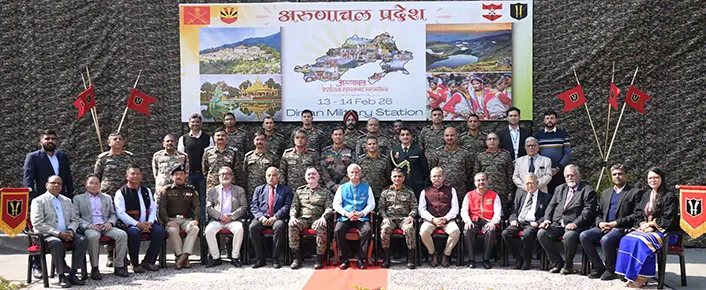
Addressing a seminar themed ‘Arunachal Pradesh – India’s dynamic frontier’ held at the headquarters of the 2 Mountain Division in Dinjan on 13 and 14 February, the governor presented a comprehensive overview of Arunachal, its people, unique dynamics, and the challenges along its borders, while also highlighting the state’s developmental progress and outlining a future roadmap.
The governor said that, along the borders with Myanmar and Bhutan, culture and security intersect in complex ways. “The Indo-Myanmar border cuts through forests and hills and remains socially open; this opens sustained livelihoods and ties under the free movement regime (FMR) but also created vulnerabilities, as insurgent groups exploited the routes. This prompted India to review the FMR to rebalance tradition and security,” Parnaik said.
He further said that, along the northern frontier, the Chinese strategy is deliberate and long-term, extending across the Line of Actual Control from Ladakh to the eastern sector. “China applies calibrated pressure by building border-proximate infrastructure, creating dual-use border settlements, and renaming places to shape narratives. To counter this and ensure deterrence, stability, and lasting control along Arunachal’s sensitive frontier, security, development, diplomacy, and community empowerment must advance together through a whole-of-nation approach,” the governor emphasised.
He said that by ensuring robust security, fostering economic growth, and leveraging technological advancements, India’s sovereignty and prosperity can be further strengthened.
The governor said that the resilience of the people living in border areas, coupled with sustained efforts towards inclusive and sustainable development, would firmly establish Arunachal as a strategic powerhouse and emerging economic hub.
“Strengthening security,” the governor said, “ensures stability and confidence, while inclusive development brings opportunity, dignity, and resilience to the people. Together, these forces shape Arunachal Pradesh’ present and will define its future as a strong, secure, and vibrant pillar of the nation.”
The governor further said that the state is witnessing a transformative phase, aligning its development trajectory with the national vision of Viksit Bharat 2047. He highlighted the strategic importance of Arunachal’s location in advancing India’s Act East policy by fostering connectivity and trade with Southeast Asia.
Complimenting the Dao Division for organising the seminar, the governor noted that the theme is especially relevant in today’s evolving security environment, more so for a frontier state like Arunachal. He emphasised that such platforms are vital for informed dialogue, meaningful reflection, and the exchange of forward-looking ideas.
Former eastern Army commander Lt Gen Rana Pratap Kalita in his address spoke about the operational realities and the broad contours of countering Chinese strategic design. Director General of Centre for Land Warfare Studies, Lt Gen Dushyant Singh, highlighted China’s designs along the Arunachal border and their strategic implications.
Former civil servant and Indian ambassador Phunchok Stobdan examined the Arunachal-Tibet linkages, culture, and their wider historical contours, while writer, military historian, and filmmaker Shiv Kunal Verma spoke on flora, fauna, ecotourism, and the region’s latent potential.
The seminar also saw participation of RIWATCH Director Vijay Swami, retired IAF group captain Mohonto Panging, and Prof Jumyir Basar and Prof Ashan Riddi from Rajiv Gandhi University, along with former Arunachal chief secretary Ramesh Negi. (Lok Bhavan)