NIRJULI, 28 Feb: The North Eastern Regional Institute of Science and Technology (NERIST) celebrated the National Science Day with great enthusiasm here on Saturday with a programme organised jointly by the NERIST’s basic science departments and its Institute Innovation Council.
The day commemorates CV Raman’s discovery of the Raman Effect on 28 February, 1928, which later earned him the Nobel Prize in 1930.
Instituted in 1986 and first observed in 1987, the occasion aims to cultivate scientific awareness and promote innovation for national advancement.
The celebration at the NERIST aligned with this year’s theme, ‘Women in science: Catalysing Viksit Bharat’, highlighting the pivotal role of women and young minds in advancing India’s scientific growth, innovation, and global leadership.
The programme was attended by, among others, NERIST Director Prof Narendranath S, and Dibrugarh University Associate Professor Gourishankar Das. Students from various neighbouring schools, including PM SHRI JNV Lakhimpur, actively participated in competitions such as poster presentation, science model competition, and quiz contests.
Addressing the participants, NERIST Chemistry HoD Dr Meera Yadav emphasised the importance of National Science Day in nurturing curiosity, innovation, and a strong research culture among students.
In their addresses, both Prof Narendranath and Prof Das underscored the significance of empowering youths through quality scientific education and interdisciplinary research to achieve the vision of a developed India.
The celebration featured an expert talk along with various competitions.
In the science model competition, VKV Nirjuli secured the first prize, while PM SHRI JNV Lakhimpur secured the second prize. In the poster presentation competition, government higher secondary school Doimukh won both first and second prizes. In the science quiz competition, KV NERIST secured both first and second positions.
The event concluded with a prize distribution ceremony, recognising the outstanding contributions of the participating students.
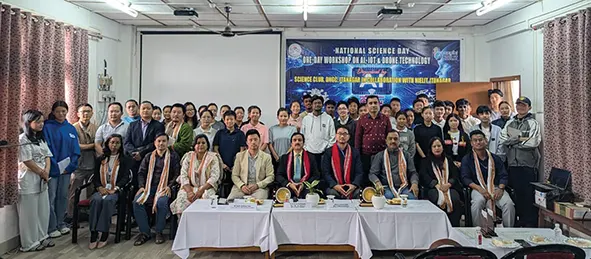
Dera Natung Government College (DNGC) also celebrated the National Science Day, highlighting scientific curiosity, ethical technology use, and emerging innovations.
DNGC Principal Dr MQ Khan underlined the relevance of science beyond laboratories and classrooms, and said that “such observances help students from all streams appreciate how scientific knowledge shapes daily life.”
Dr Khan highlighted the growing presence of artificial intelligence (AI) tools, noting that, while these platforms enhance productivity, they should never replace originality and critical thinking.
Citing the legacy of CV Raman, he urged the students to nurture analytical abilities and adopt a research-driven mindset. He further called upon students to exercise discernment in their digital engagement, warning against the spread of misinformation and the adverse effects of excessive screen time. He encouraged them to harness technology constructively while upholding integrity and social harmony.
NIELIT Itanagar Assistant Professor Dr Likha Ganu said that sustained progress in science depends on constant innovation and strong conceptual foundations, particularly in physics and mathematics. He encouraged the students to prepare themselves for opportunities in AI and data science by strengthening their basics.
The technical session featured expert talks from faculty members of NIELIT Itanagar.
Computer science lecturer Madhujya T Phukan explored the development of artificial intelligence, beginning with Alan Turing’s famous question on machine intelligence. He traced AI’s journey through landmark achievements such as AlphaGo, and spoke about ethical considerations, risks, and career avenues in the field.
Computer science department senior faculty member Dimpi Roy spoke on the Internet of Things [IoT], explaining how interconnected devices enhance efficiency across sectors including healthcare, agriculture, and industry.
Senior faculty member Moni Kumari introduced the students to drone technology, elaborating the fundamentals of unmanned aerial vehicles and their expanding applications in agriculture, disaster response, logistics, and media.
The technical session concluded with live demonstrations of AI tools, IoT applications, and drone operations, drawing enthusiastic participation from students.
The event was organised by the Science Club of the college, in collaboration with NIELIT Itanagar. (With DIPR input)