ITANAGAR, 25 Apr: Chief Minister Pema Khandu on Saturday said 19 districts of the state have become malaria-free, urging people to join hands to eliminate the disease by 2030.
On World Malaria Day, he said the elimination of the disease must become a people’s movement, urging everyone to adopt simple preventive steps that might make a big difference in the fight.
“This day reminds us of our shared commitment to eliminate malaria and ensure a healthier future for all,” he said in a social media post.
“I am proud to share that Arunachal Pradesh has made significant progress, moving from a high disease-burden state to category I (low burden) in 2022.
Today, 19 districts have achieved malaria-free status, reflecting the dedication of our health workers and communities,” he added.
Khandu said, however, that the fight is far from over.
“We aim to make Arunachal Pradesh a completely malaria-free state by 2030,” he said, urging people to consistently use long-lasting insecticidal nets, eliminate stagnant water, wear protective clothing during peak mosquito activity, use repellents indoors, and seek immediate testing in case of fever.
“Together, through awareness and action, we will build a vibrant and malaria-free Arunachal Pradesh,” he said.
World Malaria Day observed
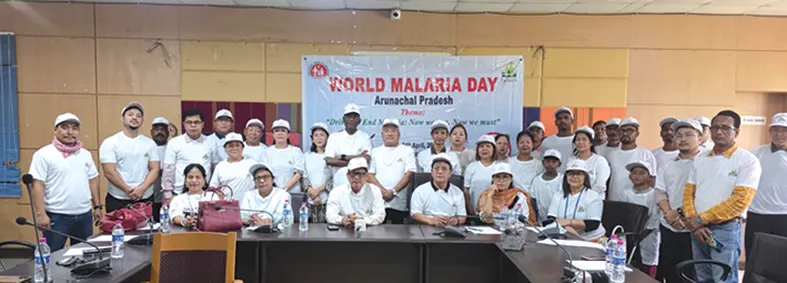
Meanwhile, the National Centre for Vector Borne Diseases Control (NCVBDC), under the Department of Health Services, observed World Malaria Day at the conference hall of the Directorate of Health Services in Naharlagun on Saturday.
The programme was organised in alignment with the national theme, ‘Driven to end malaria: Now we can. Now we must’.
Health Services Deputy Director Dr KT Mulung in his address highlighted the critical role of sustained awareness, inter-sectoral coordination, and active community participation in preventing and controlling malaria. He also shared a significant milestone in the state’s malaria elimination journey, announcing that 19 out of the 27 districts of Arunachal Pradesh have been declared malaria-free, reflecting remarkable progress in public health interventions across the state.
Furthermore, he noted that the state has now reached a low malaria burden, with only 32 reported cases in 2025, underscoring the effectiveness of ongoing control measures.
The malaria-free districts include Anjaw, Dibang Valley, East Kameng, East Siang, Kamle, Kra Daadi, Kurung Kumey, Leparada, Longding, Lower Dibang Valley, Lower Siang, Lower Subansiri, Namsai, Pakke-Kessang, Siang, Tawang, Upper Subansiri, West Kameng, and West Siang.
Dr Mulung commended the relentless efforts and dedication of healthcare workers, field staff, surveillance teams, and community volunteers whose collective contributions have been instrumental in achieving these milestones. He reiterated the department’s unwavering commitment to achieving a malaria-free Arunachal by 2027, in line with the national target.
As part of the observance, a malaria pledge and slogan session was conducted, in which all the attendees participated and reaffirmed their commitment to intensify efforts towards malaria prevention, early diagnosis, and prompt treatment. The session also highlighted the importance of community ownership in sustaining the gains achieved so far.
A short video on malaria awareness and control measures was screened during the programme. The video showcased impactful field stories, best practices, and the importance of timely intervention in reducing the malaria burden.
The event witnessed the participation of senior health officials, programme officers, consultants, field staffers, and other stakeholders, reflecting a strong collaborative approach towards malaria elimination. (With PTI input)