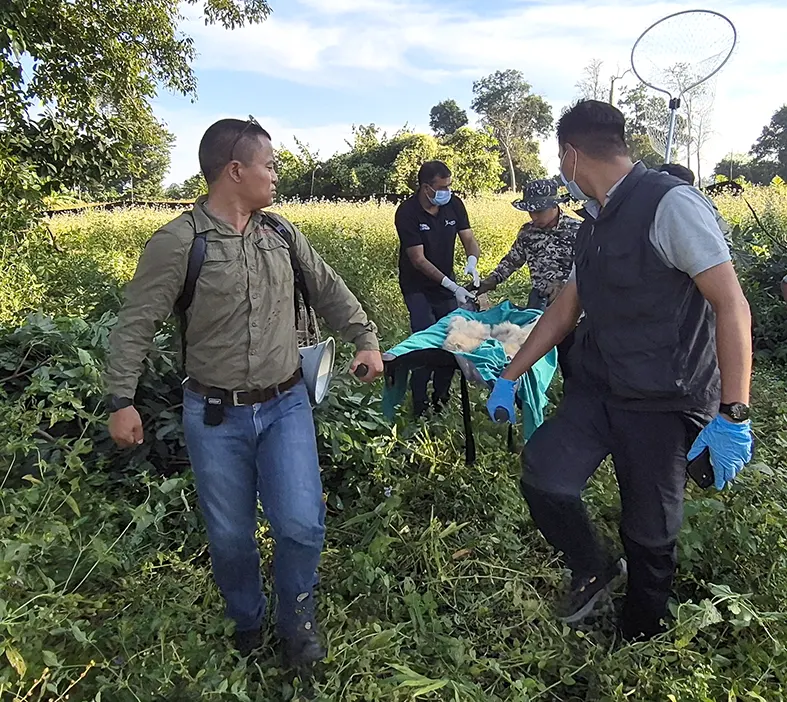
ROING, 5 Dec: A stranded family of Hoolock gibbons, comprising an adult male, an adult female, and a juvenile, was rescued from the agricultural fields of Horu Pahar village, a fringe settlement near here in Lower Dibang Valley district, after a challenging four-day operation.
All the three rescued gibbons are currently under an intensive post-release monitoring protocol. As of the morning of 5 December, they were sighted in good condition near the release site in Mehao Wildlife Sanctuary, DFO Mito Rumi said in a release.
The gibbon family had been confined to a single 45-metre-high ficus tree within a severely fragmented habitat, caused by agricultural expansion. Upon veterinary examination, the animals were found to be undernourished and underweight.
Due to the lack of continuous canopy, the arboreal apes were being forced to descend to the ground, making them vulnerable to attacks by domestic dogs and increasing the risk of genetic depression in the isolated population.
The WTI veterinary team comprising Dr. Bhaskar Choudhury, Dr. Panjit Basumatary, and Dr. Mehedi Hasan operated under the leadership of WTI director Sunil Kyarong.
The forest dept expressed gratitude to mountaineering volunteers Amaro Meto and Hachu Lombo for training the forest officials’ tree climbing team in modern rope-climbing techniques, which were crucial for the safe extraction of the animals.
Several more stranded gibbon families have been identified in agricultural landscapes of the Denlo village. Given the challenging high heights of trees and conditions, rescue operations are expected to continue for at least the next three months in staggered batches.
The Hoolock gibbon, listed under Schedule I of the Wildlife (Protection) Act, 1972, is India’s only ape species and faces severe threats from habitat fragmentation and population decline.
The forest department reiterated its commitment to protect this endangered species with strong support of the local communities.
The rescue operation was carried out by a joint team of officials from Mehao Wildlife Sanctuary and the Wildlife Trust of India (WTI).