Staff Reporter
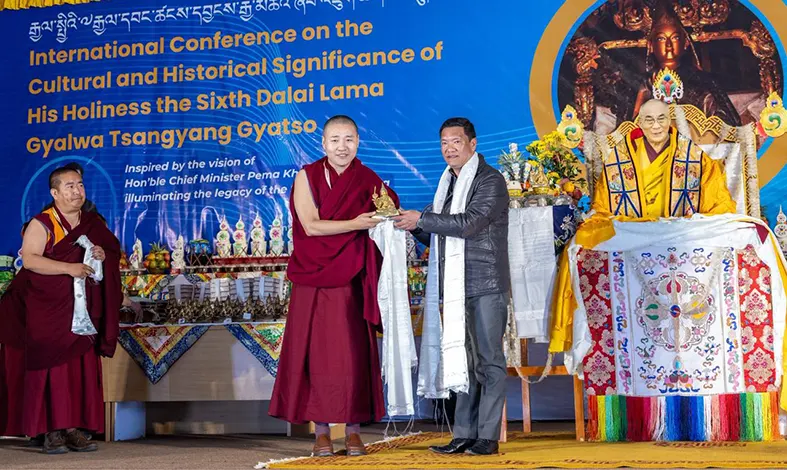
TAWANG, 6 Dec: Chief Minister Pema Khandu, speaking at the closing of the international conference on the cultural and historical significance of His Holiness the 6th Dalai Lama, Gyalwa Tsangyang Gyatso, in Tawang, said that the conference had set the path for the rediscovery of the legacy of the 6th Dalai Lama.
“We came together to rediscover a heritage that belongs not only to Tawang or Arunachal Pradesh or Tibet or the wider Himalayas, but to the entire world,” Khandu said.
Mon Tawang is the birthplace of the 6th Dalai Lama.
“We were here to reinterpret its values for our times and for times to come. We have tried to trace the spiritual, cultural, literary, and historical legacy associated with the 6th Dalai Lama. We have also reaffirmed that this legacy is not just a relic of the past. It lives on in the songs he composed and in the hearts of the people across the Himalayas, who continue to draw inspiration from his life and work,” he said.
“Let this event mark the beginning of a renewed commitment to honouring our past and shaping a future rooted in our heritage”, he said.
The Chief Minister suggested preserving heritage, protecting and promoting sites in Tawang connected to Tsangyang Gyatso’s early life, documenting and sharing local oral histories, folk songs, and legends that have survived through generations, fostering cultural and academic engagement, facilitating collaborations between local institutions and international scholars, supporting the translation and publication of his poetic works, and encouraging research that explores his life in broader historical, cultural, and philosophical contexts.
Prof. Janet Gyatso of Harvard University credited the people of Monyul for preserving the Dalai Lama’s possessions, residences, miraculous carvings, footprints, and folk songs to such an extraordinary degree.
“Such local memory gives us a way to track a different kind of history when more conventional documentation is missing,” she said.
“I especially appreciated the various attempts to understand Tsangyang Gyatso as a human being-a complex figure who stands somewhere on the spectrum between Samsara and Nirvana.”
Director of the Department of Karmik and Adhyatmik Affairs, Thupten Kalden said, “The main purpose of this conference was to create awareness among our younger generations about the Dalai Lama institution and to foster a close connection with the Dalai Lamas, especially through the 6th Dalai Lama.”
The proceedings will be published in various formats, the Director informed.
CCRD Executive Director Moji Riba said, “His Holiness the 6th Dalai Lama brought people together-even today, after centuries-across classes and nationalities. That only proves that compassion truly transcends boundaries and histories.”
He added that during the conference there had been debates and disagreements, but what was important was that there had been meaningful discourse about the 6th Dalai Lama.
Among others, Tulku Tenzin Gyurmey Rinpoche, President of the Thubten Shedrubling Foundation and Chairman of the organising committee, also spoke on the occasion.
An array of scholars from India and abroad, as well as Rinpoches-including the Venerable Yangteng Rinpoche, an eminent scholar and Secretary at the Office of His Holiness the 14th Dalai Lama-attended the three-day event, which was organised by the Thubten Shedrubling Foundation, Department of Karmik and Adhyatmik Affairs, the Government of Arunachal Pradesh, and Centre for Cultural Research and Documentation.