ITANAGAR, 8 Feb: “Our faith, culture, language and traditions are inseparable. If we lose our roots, we lose our identity,” said Chief Minister Pema Khandu, adding that preservation of indigenous faiths should never be misconstrued as opposition to any other religion.
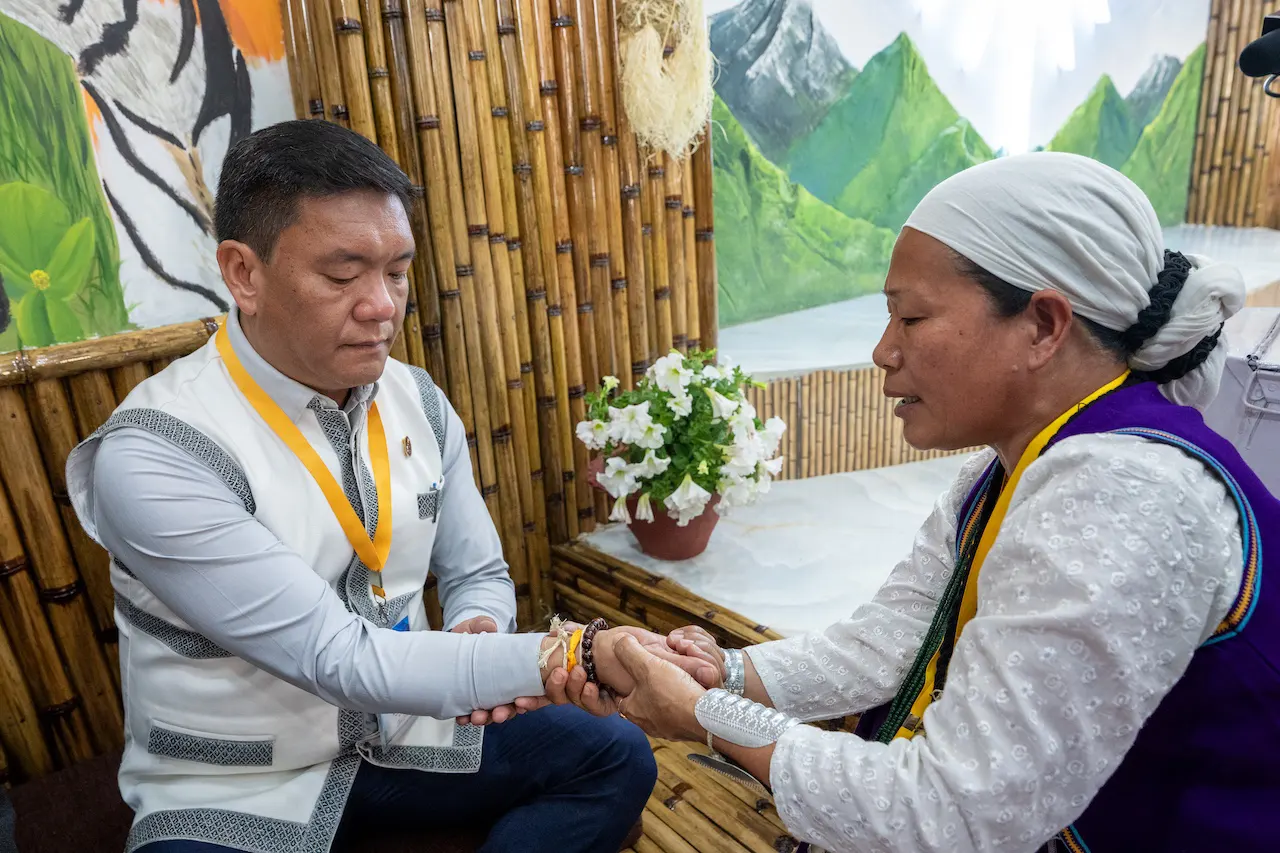
The chief minister said this after inaugurating a newly consecrated Donyi Polo Kargu Gamgi, a Donyi Polo prayer and cultural centre, in Modirijo here on Sunday.
Addressing the gathering, the chief minister congratulated the Itanagar Donyi Polo Kargu Gamgi Council, the Central Donyi Polo Kargu Gamgi Council, and all contributors for translating a long-cherished vision into reality through collective effort and public participation. He noted that more than 700 donors, largely from the Galo community, contributed to the construction of the centre, calling it a shining example of community-led cultural preservation.
“This gamgi is not just a structure; it represents our roots, our faith and our identity. Your contributions have been meaningfully transformed into a permanent cultural and spiritual institution,” Khandu said.
Highlighting the age-old lineage of indigenous faith systems, Khandu said that indigenous belief systems have existed for thousands of years and form the original spiritual foundation of tribal societies not only in Arunachal Pradesh but across the world. He observed that while modernisation and social change have reduced the number of followers globally, there is now a renewed international movement to revive and protect indigenous faiths, cultures and traditions.
Khandu emphasised that Arunachal is home to diverse indigenous belief systems, each deeply embedded in the identity of its respective community. To safeguard these traditions, he said, the state government has established the department of indigenous affairs, which is working to support faith-based cultural infrastructure such as kargu gamgi, nyedar namlo, ganggi, and other indigenous prayer and cultural centres across tribes.
“India is a secular country, and every individual is free to practise any religion. Protecting our indigenous faith is about safeguarding who we are, not opposing anyone else,” he said.
Khandu also recalled key initiatives taken by the government to strengthen indigenous identity, including the official gazette notification declaring 31 December as Donyi Polo Day, approval of the NiminAalo celebration to honour women, and naming the state’s first greenfield airport as Donyi Polo Airport.
The chief minister highlighted the evolution of the organised kargu gamgi prayer system, which took a structured form in the early 2000s, giving collective expression to an ancient indigenous faith. He said that the gamgi institution symbolises collective prayer, healing, peace and wellbeing, and has steadily grown into a unifying force for believers in the capital region and beyond.
He particularly commended the inclusive and reformative nature of the kargu gamgi movement, “where common people actively participate in prayer and spiritual practices, strengthening social harmony, unity and shared moral responsibility within the community.”
In the context of rapid modernisation and global influences, the chief minister observed that indigenous belief systems face increasing challenges, especially among younger generations. Institutions like the kargu gamgi, he said, play a crucial role in preserving, practising and transmitting indigenous faith and values in an organised and meaningful manner.
Drawing parallels with the Buddhist education system in the Tawang region, the chief minister underlined the importance of integrating indigenous faith systems with formal education to ensure their long-term survival. He announced that the state government, in collaboration with institutions such as the International Centre for Cultural Studies (ICCS), RIWATCH (Roing) and the Indigenous Faith & Cultural Society of Arunachal Pradesh (IFCSAP), is working towards establishing a dedicated university for indigenous studies. The proposed institution will focus on research, documentation, education and curriculum development for indigenous faiths and cultures of Arunachal.
“This university will ensure that our indigenous knowledge systems are properly documented, researched and passed on to future generations in a structured manner,” he said, adding that consultations with senior priests, cultural leaders and scholars would form the foundation of its academic framework.
The chief minister further shared plans to promote global exchange and learning by facilitating study visits to countries such as Japan, where indigenous practices like Shintoism have been successfully preserved alongside modern development. He also expressed intent to host international conferences in Arunachal on indigenous faith and cultural practices.
Appealing for harmony and mutual respect, Khandu urged people to refrain from using divisive language on matters of faith. He reiterated that while laws and committees – such as those examining matters related to religious freedom – play an important role, the true preservation of culture lies in everyday practice by individuals and families.
Encouraging people to practise indigenous rituals in daily life, he said even small prayer spaces in homes help strengthen spiritual connection and cultural continuity.
“Faith is a way of life. It must be lived, not merely spoken about,” he said.
Assuring of continued government support, the chief minister said that budgetary allocation for the department of indigenous affairs would be enhanced to facilitate construction and strengthening of indigenous cultural centres across all communities. He further suggested that a state-of-the-art Donyi Polo prayer-cum-cultural centre may be planned in the state capital, and assured of government support “as and when it materialises.”
The programme was attended by ministers PD Sona and Kento Jini, Itanagar Municipal Corporation Mayor Likha Nari, MLAs, senior community leaders, members of the Donyi Polo Kargu Gamgi councils, district administration officials, and a large number of devotees and well-wishers. (CM’s PR Cell)