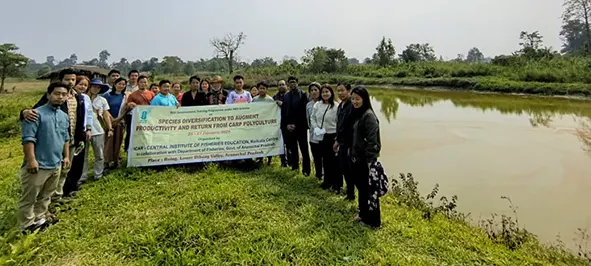
ROING, 27 Feb: A three-day skill development training programme on ‘Species diversification to augment productivity and return from carp polyculture’ was conducted by the Central Institute of Fisheries Education’s (CIFE) Kolkata Centre, in collaboration with the fisheries department here in Lower Dibang Valley district on recently.
The programme was aimed at empowering fish farmers by imparting practical knowledge and skills to meet the increasing fish demand. The objective is to increase the income of socially backward farmers by at least two-fold, thus improving their livelihood standards and ultimately enhancing the total fish production of the state.
The training programme was inaugurated by progressive farmer Jatin Pulu, who underscored the importance of adopting scientific fish farming to increase productivity and double farmers’ incomes. He motivated the farmers to make full use of the CIFE initiative to bring more areas under modern fish culture methods and increase fish production in the district.
District Fisheries Officer Neriyang Jamoh highlighted the importance of advanced aquaculture methods to augment fish production, and commended the CIFE for providing the training to benefit the fish farming community. She urged the participants to make full use of the knowledge and skills developed through the programme, along with critical inputs such as lime, soil and water test kits, study materials, etc, to manage their culture ponds.
CIFE Kolkata Centre principal scientist Dr GH Pailan conducted various theory and hands-on classes on nursery and rearing pond management for raising carp; feed and feeding strategies in aquaculture; and on-farm cost-effective feed formulation and preparation. He also suggested using high-value fish species in aquaculture to increase returns from existing farming systems.
CIFE scientist Dr Dilip Kumar Singh conducted theory and hands-on classes on composite fish culture, species diversification, analysis of soil and water quality parameters, and fish health and disease management.
Twenty-five fish farmers actively participated in the programme and received critical inputs for fish farming.