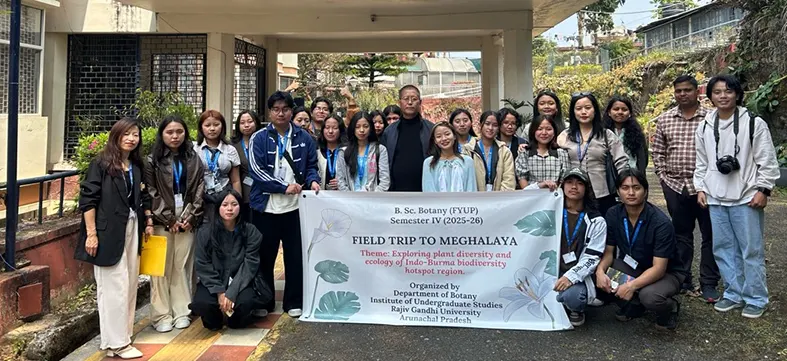
RONO HILLS, 29 Mar: Nineteen BSc botany 4th semester students of the Institute of Undergraduate Studies (IUGS) at Rajiv Gandhi University (RGU) here were taken on a field trip to Meghalaya from 25-29 March.
The students were led by teaching assistants Dr Hage Asha, Dr Hage Yakang and Dr Jenima Basumatary, under the guidance of IUGS Director Prof SK Patnaik.
During the study trip, the group visited the Botanical Survey of India’s (BSI) eastern regional centre in Shillong, where they participated in a technical session on herbarium techniques, presented by Dr Harekrushna Swain, senior preservation assistant. “The students were introduced to the core aspects of plant taxonomy and systematics on the methods of plant collection, preservation, mounting, and documentation,” the university informed in a release.
The students also toured the herbarium and the orchidarium, gaining firsthand exposure to curated plant specimens and regional biodiversity, followed by a field visit and an interactive session with BSI Head Dr Nripemo Odyuo.
This experience directly complemented the students’ curriculum by bridging theoretical knowledge with practical taxonomic skills.
The students also visited Dawki, near the India-Bangladesh border, where they observed the unique riverine ecosystem of the Umngot river, which isecologically significant for its exceptionally clear, oligotrophic waters that support diverse aquatic life and reflect low levels of pollution. They then proceeded to Mawlynnong, known as Asia’s cleanest village, where they witnessed exemplary models of sustainable resource management and community-led conservation practices. The students observed how local traditions and collective responsibility contribute to maintaining environmental quality.
The visit to the ‘living root bridge’ in Riwai further illustrated nature-based solutions and bioengineering, highlighting the intricate relationship between human communities and ecological systems.
Overall, the field trip provided a broader exposure to the students beyond their immediate geographical region, and an integrative learning experiencereinforcing concepts of plant taxonomy, systematics, and ecology through direct engagement with biodiversity, conservation practices, and traditional ecological knowledge.