[ Yomli Mayi ]
Since time immemorial, the tribal council has been the bedrock of justice in Arunachal Pradesh – resolving thefts, boundary disputes, and customary law matters at the village level. Growing up here, I watched disputes get settled in the ‘DeRv’ (community building). The community deliberated and delivered – not always perfectly, but with a moral authority that everyone understood and, more importantly, accepted.
Yet, as education spreads and modern governance penetrates deeper into tribal life, citizens have increasingly turned to the Constitution and formal law to address conflicts that once stayed within community boundaries. That is not a bad thing – it is exactly what a modern democracy should offer – but only if those institutions actually deliver. And in Arunachal, with population growth bringing up the inevitable rise in crimes, they are failing to do so with alarming consistency.
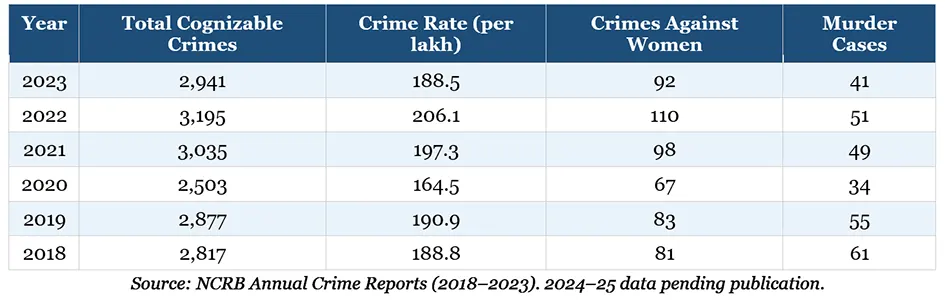
According to the most recent data available from the National Crime Records Bureau (NCRB) 2025 report, Arunachal recorded 2,941 cognisable crimes in 2023, including 41 murders and 18 attempts to murder. The six-year trend tells a sobering story:
These are reported figures only. Given the state’s vast, remote, and tribal-dominated terrain, under-reporting in border areas and interior districts remains a chronic problem – the real numbers are almost certainly higher. In 2025 alone, total FIRs registered stood at 3,145, including 36 murder cases and 88 rape cases, up from 3,012 in 2024, according to the state’s home department. That upward trajectory is not a statistical curiosity. It is a warning that has been issued repeatedly and is still not receiving the urgency it demands.
The list of heinous incidents in 2025-26 reads like a state in crisis – and each number in those tables was a person.
In July 2025, a 19-year-old migrant labourer from Assam, Riza-ul Kurim, was accused of sexually assaulting three to four minor girls aged 6-8 residing in a school hostel in Roing, Lower Dibang Valleydistrict. The hostel had no warden and virtually no oversight. Police arrested him following a parent’s complaint. The next day, a mob of 400-500 enraged locals stormed the Roing police station, dragged the accused out of custody, tied him to a tree, and beat him to death. Section 144’s curfew was imposed, and the school was sealed indefinitely.
Both the rape case and the lynching remain under investigation, but the episode exposed something far more alarming than a single crime – a community so deprived of faith in the system that it turned to street execution. I am not romanticising what that mob did. It was wrong. But when a community does not believe the state will deliver justice, it eventually stops waiting for one.
The months that followed brought no respite. In September 2025, two senior doctors at the TRIHMS were brutally attacked inside the ENT ward with iron rods and sharp weapons. In October 2025, LikwangLowang, a senior official, died by suicide amid a controversy that also claimed the life of 19-year-old Gomchu Yekar, who took his own life, accusing senior IAS officers of sexual exploitation. In November 2025, veteran teacher Sukumar Chowdhury was found dead in his staff quarters at Ramakrishna Mission School, Aalo – registered as an unnatural death. The June 2025 protest over the murder of Prabash Doley in Itanagar drew massive public demonstrations.
As 2026 began, violence only intensified. In March 2026, a father and his young daughter were brutally killed in New Kamlao village, Changlang district. A clerk, Chungma Bagang, was murdered near the Hollongi road. A government engineer was arrested for allegedly raping a 14-year-old domestic help. Five men were arrested for kidnapping and gang-raping a 13-year-old girl for five days in Daporijo. Tawang, East Kameng, and Lower Subansiri districts all reported fresh POCSO cases.
Then, on the night of 7-8 April, 2026, Yapi Potom – a 42-year-old widowed junior teacher at Government Secondary School, Chimpu, and mother of two young children – was hacked to death with a dao near her Itanagar residence. The accused, Daksen Riram, was arrested within hours. Yet, rather than relief, the arrest triggered massive candlelight marches across the state. The Arunachal Teachers’ Association (ATA) asked the question that everyone was already thinking: How many more Yapi Potoms must we lose before the state wakes up? The anguish was not just for one woman – it was a collective indictment of the system.
Why law and order is failing
The reasons for this collapse are structural, not incidental.
First, the police infrastructure is critically understaffed. According to the home department, the state requires 118 police stations to cover all administrative circles, yet only 102 are functional. Required personnel across all categories stand at 15,500, but the actual deployed strength is just 12,500 – a shortfall of 3,000 officers. While the United Nations recommends a minimum of 222 police personnel per 1,00,000 people, and India’s national average stood at approximately 155 as of early 2024, Arunachal’s projected population of 1.89 million for 2025-26 yields a ratio of roughly 661 police per lakh – better in raw numbers, but severely mismatched against the operational reality of policing a geographically enormous, terrain-challenged frontier state. Vast distances, dense forests, and limited connectivity mean thin police presence precisely where crimes occur and go unreported.
Second, judicial delays corrode public faith. Even when arrests are swift – as in the Yapi Potom and Roing cases – trials drag on for years. Low conviction rates and occasional perceptions of political interference in high-profile cases further alienate citizens. The November 2025 conviction of Bomdo Tali by a Pasighat POCSO court, who received a 20-year sentence for rape, offers a rare ray of hope – but it is the exception, not the rule. The Roing mob did not act out of bloodlust alone; it acted because it did not believe the state would deliver justice. That calculation, however horrifying, reflects a rational response to repeated institutional failure.
Third, governance lapses create fertile ground for crimes. School hostels – particularly in missionary and private institutions – operate with minimal oversight, as the Roing case grotesquely exposed. Women police stations exist but lack adequate reach and resources. Government responses remain reactive: swift arrests are announced, assurances of scientific evidence are offered, and then the cycle repeats. The Arunachal Pradesh Women’s Welfare Society (APWWS) and teachers’ unions have repeatedly held candlelight marches demanding action – not as a ritual of grief, but as a cry that rhetoric must give way to reform.
The consequences of this sustained lawlessness extend far beyond individual tragedies. Women and children in hostels and remote villages live in constant fear. Teachers like Yapi Potom’s colleagues question their own safety walking home from work. The rise of mob justice – seen in Roing and reflected in public sentiment across multiple protests – represents a profound civilisational failure: the state has lost its monopoly on legitimate enforcement. Each act of vigilante violence risks communal tensions in a state whose diversity – tribal identities, migrant labour populations, and a complex ethnic system make such escalation particularly dangerous for the state’s long-term development, and the implications are dire.
Healthcare workers attacked inside a hospital; teachers murdered on public roads; children assaulted in school dormitories – these are not just crimes. They are signals of an unravelling social contract.
The way forward
Restoring law and order in Arunachal demands urgent, multi-pronged reforms: strengthen policing infrastructure by filling the 3,000-strong personnel gap, establish the remaining 16 police stations, and deploy dedicated women officers in every district with resources to match their mandate. Community policing models adapted to tribal contexts can bridge trust deficits in remote areas.
Establish fast-track courts exclusively for POCSO, rape, and murder cases, with strict, enforceable timelines for trial disposal. Judicial delay is not a neutral administrative failure; it is an active driver of mob justice. Mandate hostel safety audits for all school hostels – government, missionary, and private – with immediate, non-negotiable minimum standards: resident wardens, CCTV coverage, and regular inspections. The Roing tragedy could have been prevented.
Invest in modern forensic infrastructure, inter-district coordination technology, and trauma-informed training for officers handling sexual violence and crimes against children.
Demonstrate political will through accountability. Independent investigations into institutional lapses, public dashboards tracking case progress, and sustained engagement with civil society groups like the APWWS and ATA are not optional niceties – they are prerequisites for rebuilding public trust.
The murders, rapes, lynchings, and suspicious deaths catalogued here are not statistical anomalies. They are the visible symptoms of a system under strain – and in some places, outright collapse.
The tribal council was never designed to bear this burden alone. It was a community institution built for community-scale problems. As Arunachal has grown in population, complexity, and the ambition of its citizens, the responsibility for justice has shifted to institutions that were supposed to rise to meet it. They have not risen – and the people of this state are no longer asking quietly.
From the bloodied streets of Roing to the candlelit vigils for Yapi Potom in Itanagar, the message is unambiguous: patience has run out. The cost of further delay is not measured in budgets or timelines. It is measured in lives. Arunachal’s future as a safe, progressive, and investment-worthy frontier state depends entirely on whether its government, police, and judiciary can close the yawning gap between promise and performance. The cost of further delay is measured not in budgets, but in lives. (The contributor is an independent observer)