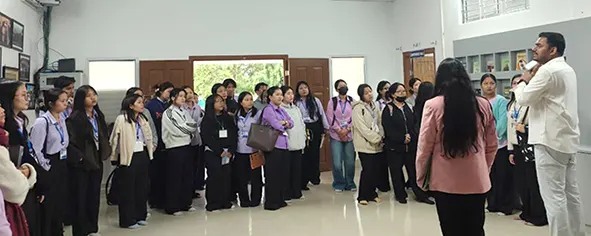
ROING, 13 Apr: Continuing its outreach efforts to engage future educators with the importance of preserving indigenous languages and cultural heritage, the Research Institute of World’s Ancient Traditions, Cultures and Heritage (RIWATCH) organised an ‘in-reach’ orientation programme at its campus in Lower Dibang Valley district on Sunday.
The programme saw the participation of 46 BEd students and three faculty members from Kasturba Gandhi Institute of Higher Education, Kebali.
Continuing the initiative, Sunday’s session placed greater emphasis on interaction and reflection through a mandal – a collaborative learning circle where participants come together for discussion, reflection, and collective understanding. Students were encouraged to share their observations and engage in meaningful discussions on the relationship between education, culture, and identity.
A central feature of the programme was the ‘mandal activity’, during which participants were divided into three groups – Mishmi, Wancho, and Adi mandal. Each group discussed two themes: what they had learned from the RIWATCH beyond textbooks, and how teachers can contribute to the preservation of language and culture.
The discussions revealed thoughtful responses from the students. Many spoke about the need for teachers to move beyond conventional teaching methods and include local languages, traditions, and community knowledge in the classrooms. They observed that teachers can play a vital role in nurturing respect for indigenous identity by encouraging the use of mother tongue and by connecting lessons with lived cultural experiences. Several participants also noted that when students see their own culture reflected in education, it builds confidence and a stronger sense of belonging.
Students described their visit as an eye-opening experience. Exposure to traditional artefacts, ways of life, and belief systems helped them better understand the diversity and depth of Arunachal Pradesh’ indigenous heritage. The visit also highlighted the importance of documentation and preservation, especially at a time when many languages and traditions are gradually declining.
Participants appreciated the work being carried out by the RIWATCH, particularly its role in research and documentation, and in creating a learning environment that blends culture with education.
The programme concluded with group presentations, where each mandal shared its key takeaways. The overall sentiment reflected a common understanding- that education should not remain confined to textbooks, but must also draw from culture, community, and lived realities.