

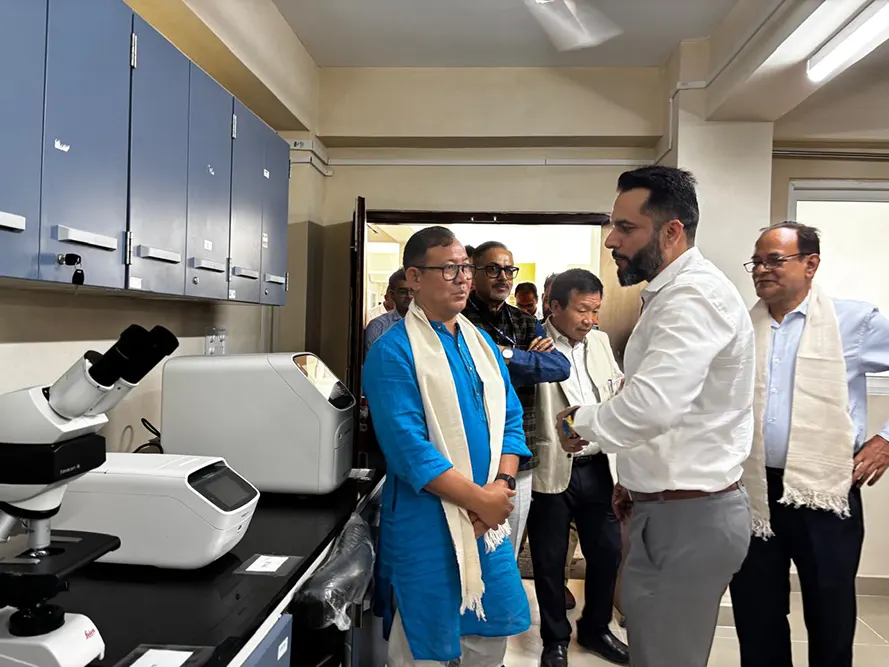
RONO HILLS, 8 May: A state-of-the-art honey testing laboratory was launched at the food technology department of Rajiv Gandhi University (RGU) here on Friday.
The initiative is part of a comprehensive project funded by the National Bee Board (NBB) and implemented by NECTAR (North East Centre for Technology Application and Reach), in collaboration with RGU.
The event witnessed the presence of Doimukh MLA Nabam Vivek, RGU Vice-Chancellor (i/c) Prof SK Nayak, Tezpur University Pro-Vice-Chancellor Prof Amarendra Kumar Das, NECTAR Director General Dr Arun Kumar Sarma, and RGU Registrar Dr Nabam Tadar Rikam, among others.
The programme reflected strong collaboration among academic institutions, government agencies, and technical organisations towards strengthening the apiculture ecosystem in the region. The project coordination and implementation activities at RGU are being carried out under the leadership of Dr Sandeep Janghu, along with Dr NRNV Gowripathi Rao, Dr Saxena RPN, and Dr Ashok Kumar Yadav, who are serving as coordinators for the initiative. Their collective efforts have significantly contributed to the successful planning, execution, and management of the honey testing laboratory and associated infrastructure development activities aimed at promoting scientific apiculture and livelihood generation in Arunachal Pradesh.
MLA Vivek in his address emphasised the importance of scientific beekeeping and value-added honey production for rural economic growth. He highlighted the need to empower local farmers and youths through technology-driven initiatives, and assured of continued support to expand livelihood-focused interventions across Arunachal to strengthen market linkages and entrepreneurial opportunities in the region.
Prof Das and Prof Nayak highlighted the crucial role of academic institutions in promoting research-driven agricultural innovation. They emphasised the importance of quality testing and certification in ensuring market competitiveness, encouraging inter-institutional collaboration to develop sustainable apiculture models, and creating opportunities for student engagement, research, and skill development through the facility.
Dr Sarma underscored the NECTAR’s commitment to technology-driven livelihood enhancement in Northeast India. He highlighted the significance of integrated infrastructure involving testing, processing, storage, and marketing in apiculture. He described the initiative as a replicable model for rural development and income generation through scientific beekeeping. He also emphasised the use of digital tools and monitoring systems for transparency and efficiency.
The dignitaries collectively highlighted the long-term impact of the honey testing laboratory and associated infrastructure on local development, emphasising its immense potential for large-scale livelihood generation through apiculture.
They noted that the establishment of scientific testing, processing, storage, and value-addition facilities would significantly strengthen the honey value chain in Arunachal, enhance farmers’ income, create employment opportunities for rural youths and women, and promote entrepreneurship in the region.
The initiative is expected to transform apiculture into a sustainable and commercially viable livelihood sector for local communities.
The inauguration of the honey testing laboratory and the initiation of the honey processing unit mark a significant step towards creating a robust, technology-driven apiculture ecosystem in Arunachal. The collaborative efforts of the NECTAR, RGU, and the NBB are expected to empower local communities, enhance honey quality, and position the region as a key contributor to India’s beekeeping sector.