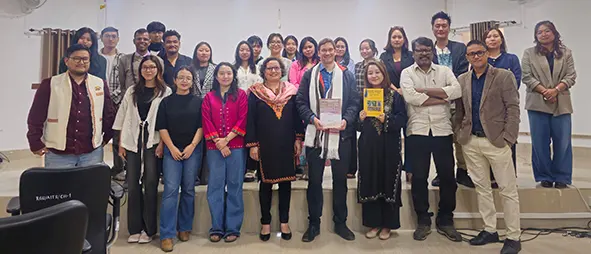
DOIMUKH, Jan 27: The Arunachal Institute of Tribal Studies (AITS), Rajiv Gandhi University (RGU), organised two special in-house lectures delivered by Prof Dr Tim Bodt, associate professor at the School for Linguistic, Speech and Communication Sciences, Trinity College Dublin, Ireland.
The lectures were titled ‘State of the Art in Linguistic and Ethnographic Research in Western Arunachal Pradesh’ and ‘Trinity College Dublin, the School for Linguistic, Speech and Communication Sciences, the Trinity Centre for Asian Studies and Possibilities for Academic Cooperation with RGU, Doimukh’.
The sessions aimed to present the current status of linguistic and cultural research in the region, identify major research gaps, and suggest potential research designs for postgraduate, doctoral and postdoctoral studies.
Research scholars and faculty members interacted with Prof Bodt on key research areas in western Arunachal Pradesh, funding opportunities, and the need for collaborative research initiatives in Asian studies.
During the programme, Prof Bodt, who is also the deputy director of the Trinity Centre for Asian Studies and principal investigator of the five-year European Research Council-funded project Lo-Rig, donated his book Proto-Western Kho-Bwa: Reconstructing a Community’s Past through Languages. The book focuses on eight varieties of Trans-Himalayan languages-Khispi, Duhumbi, Sartang and Sherdukpen-spoken by around 6,000 people in western Arunachal Pradesh. The study provides ethnolinguistic and historical backgrounds of these languages and offers detailed phonological descriptions of each variety.
The publication represents one of the first systematic attempts to document the phonology of these languages. Prof Bodt’s scholarly contributions also include the compilation of dictionaries, documentation of folktales and extensive descriptive linguistic research.
Expressing concern over language endangerment, Prof Bodt noted that younger speakers are increasingly shifting towards Arunachalee Hindi, posing serious risks to indigenous languages. He explained the distinction between language and dialect, stating that mutual intelligibility across villages often determines dialectal status, while acknowledging that such classifications may be influenced by political and social factors. He identified languages such as Bugun as highly endangered and stressed the need for comprehensive grammatical descriptions. Hruso was described as phonologically complex, while Tsangla was noted as linguistically unclassified and requiring further research.
Emphasising the importance of ethnographic and anthropological research, Prof Bodt highlighted themes such as identity, indigeneity, border politics and language endangerment. He encouraged interdisciplinary and multidisciplinary approaches, recommended the use of e-language tools for transcription and translation, and observed that the absence of archaeological evidence does not necessarily indicate the absence of historical or transitional traces.
The session concluded with an interactive discussion that encouraged students and researchers to engage more deeply in the documentation and preservation of the linguistic and cultural heritage of western Arunachal Pradesh.