[ Amar Sangno ]
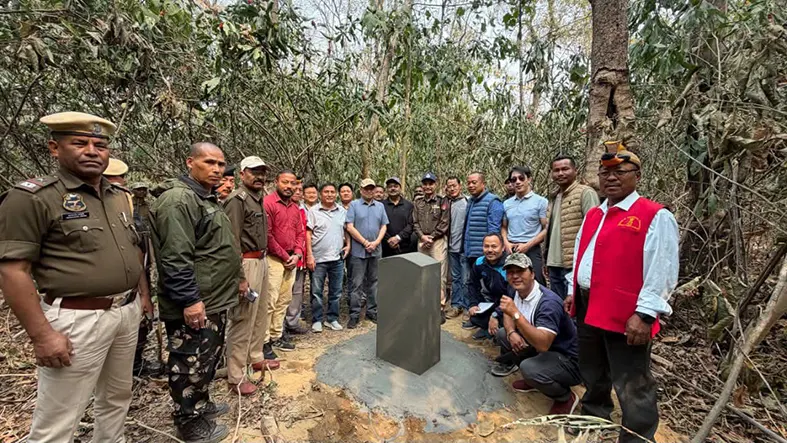
SEIJOSA, 22 Feb: In a significant development in the Arunachal Pradesh-Assam boundary dispute resolution, the first official border pillar was erected at Seijosa in Pakke-Kessang district, along Biswanath district of Assam, on Sunday, marking a permanent settlement to the decades-old boundary dispute between Arunachal and Assam.
The border pillar was jointly erected by both Arunachal and Assam. Health & Family Welfare Minister and local MLA Biyuram Wahge, Pakke-Kessang Deputy Commissioner Bani Lego, Zilla Parishad Chairperson Pani Tayem, Pakke Tiger Reserve DFO Dhawan Rawat, Khellong DFO Suman Beniwal, Assistant Commissioner Kesang Wangda, Circle Officer Nima Phunstok, and HGB Takam Nabum represented the Arunachal side.
The Assam side was represented by Biswanath District Commissioner Lakhinanda Saharia, SSP Ajagwran Basumatary, Sonitpur DFO (Wildlife) Pirai Soodan B, Biswanath Revenue Circle CO Madhuriya Parasar, and Naduar Revenue Circle CO Akashdeep Kakoti.
The teams jointly erected the border pillar, which was witnessed by Swaine Shree Rakesh Kumar, an official from the Survey of India.
It is learnt that three types of pillars would be erected – primary, secondary and tertiary – along the Arunachal-Assam boundary as part of the permanent boundary settlement. The primary pillar has been erected for demarcation; secondary pillars will be constructed wherever there are curves in the boundary, and tertiary pillars will be constructed mainly in the settlement areas where clearer demarcation may be required.
A stretch of nearly 38.4 kilometres falls under Pakke-Kessang district, which shares boundary with Assam. Among the stretches, Dikalmukh is considered the most contentious area. It was also informed that Dikalmukh has a certain portion that needs final approval from the regional committee for installation of boundary pillars.
The joint boundary pillar installation is an outcome of the resolution taken during a joint coordination meeting between the respective Arunachal and Assam deputy commissioners on 22 January, 2026 over a joint pilot survey and boundary demarcation work between Pakke-Kessang and Biswanath districts.
The installation of the boundary pillar reflects the spirit and commitment of the Namsai Declaration, signalling a transition towards peaceful coexistence, administrative clarity and long-term stability for communities residing in the border areas. The exercise was carried out under the close coordination of a joint team of senior officials from both Arunachal and Assam, ensuring mutual agreement and on-ground accuracy.
Speaking to The Arunachal Times, minister Wahge termed the installation of the boundary pillar a historic event to end the longstanding dispute between Arunachal and Assam over the boundary. “This permanent settlement of boundary dispute is possible because of painstaking efforts jointly put by our Chief Minister Pema Khandu and his Assam counterpart Himanta Biswa Sharma under the guidance of Prime Minister Narendra Modi and Home Minister Amit Shah,” said Wahge.
“I am thankful to both chief ministers for their commitment towards permanent boundary dispute settlement, and our Home Minister Mama Natung and Assam WRD Minister Pijush Hazarika, both local MLAs of Biswanath and Sonitpur districts Assam, the administrative officers, the police force, forest officials, Survey of India officials and the public of both Arunachal and Assam for making the permanent settlement possible,” Wahge added.
Acknowledging the development, Chief Minister Pema Khandu termed it a significant achievement in the ongoing demarcation process. He stated that the progress is the result of sustained dialogue and proactive leadership, particularly acknowledging the efforts of minister Wahge, chairman of the regional committee for Pakke-Kessang.
The chief minister also credited the dedicated involvement of the district administrations and local representatives from both states for ensuring smooth coordination and consensus.
According to Khandu, the Seijosa border pillar sets a blueprint for the remaining demarcation work, strengthening cooperation between the two neighbouring states and paving the way for lasting harmony, development, and confidence among the residents living in the border regions.