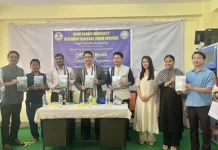
ITANAGAR, 25 Feb: A survey-based assessment of media professionals in Arunachal Pradesh has highlighted low income levels, limited workplace protections and exposure to editorial pressure as key challenges facing journalists and media workers in the state, according to a report released by the Himkai Research Initiative (HRI).
Titled “Media Work and Newsroom Realities in Arunachal Pradesh (2025-26),” the study is based on responses from 52 media professionals across print, digital, visual and social media platforms, collected between 20 December, 2025 and 2 January, 2026.
The report describes the state’s media ecosystem as increasingly digital and relatively young, but operating under structurally fragile conditions characterised by modest income levels, unpaid labour and gaps in institutional support.
According to the findings, the median monthly income among respondents was Rs 20,000, with the middle 50 per cent earning between Rs 15,000 and Rs 30,000. Around 82.7 per cent reported not receiving employer-provided health benefits, while 69.2 per cent said they worked unpaid overtime either regularly or occasionally.
The study also flagged concerns over editorial independence and workplace safety. About 65.4 per cent of respondents said they had faced pressure to modify or withhold news content, and 50 per cent reported experiencing threats, harassment or attacks related to their work. Only 26.9 per cent said they received regular editorial or safety training.
The survey recorded an average job satisfaction score of 3.44 on a five-point scale and a perceived public trust score of 3.33, suggesting moderate levels of confidence among media workers regarding their profession and public perception.
In terms of employment structure, 75 per cent of respondents identified as full-time workers, while 57.7 per cent said they had written employment contracts. However, the report noted that formal contracts did not always translate into financial or social protections, with salary delays and lack of benefits remaining common concerns.
The study observed that the majority of responses were concentrated in the Itanagar-Naharlagun region, and described the findings as exploratory rather than statistically representative of the entire state.
The report said journalism in Arunachal Pradesh operates within a distinct geographic and social context marked by dispersed populations, difficult terrain and fast-evolving digital communication platforms. While the workforce was described as dynamic and mission-driven, structural vulnerabilities such as revenue challenges, lack of training and limited safety mechanisms were identified as systemic concerns.
Key areas identified for strengthening the sector included community support for journalism, sustainable funding models, professional training, mentorship and stronger legal and safety safeguards.
The Himkai Research Initiative said the report is intended to serve as a baseline for further research and policy dialogue on media labour conditions, newsroom practices and the broader information ecosystem in Arunachal Pradesh.