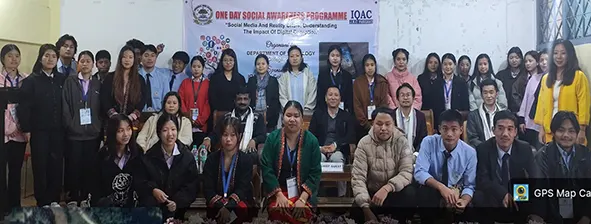
PASIGHAT, 17 Mar: The sociology department of Jawaharlal Nehru College (JNC) here in East Siang district organised an awareness programme titled ‘Social media and the reality crisis: Understanding the impact of digital deception’ on Tuesday.
The programme aimed to equip students with the critical thinking tools necessary to navigate the increasingly blurred lines between the physical world and the mediated digital landscape.
Addressing the participants, Sociology HoD Tobom Lollen emphasised that in the contemporary digital era, understanding the sociology of the internet is no longer optional but a necessity for informed citizenship.
Assistant Professor Tamin Mili delivered a lecture on how human understanding of reality is being reshaped. Drawing from sociological understandings,he noted that while reality has always been socially constructed, digital platforms are now hijacking this role. He further explained concepts like hyper-reality,simulations and mediated representations, and warned that power structures embedded in algorithms now decide what people perceive as truth, “leading to echo chambers and unrealistic expectations.”
JNC IQAC coordinator Dr DP Panda described social media as a double-edged sword. “While it facilitates instant information, it has contributed to a visible decline in reading habits,” he said, and urged the participants to “verify every piece of content before hitting ‘forward’.”
JNC Vice Principal Dr Leki Sitang provided a sobering reflection on the “media revolution.” He observed that students are becoming increasingly dependent on AI and social media, which is stunting experiential learning and curiosity. Citing the recent JNC hostel case as an example, he noted how people are easily carried away by trends without verifying background information.
During the technical session, Arunachal Pradesh University’s Mass Communication Assistant Professor Dr Kombong Darang focused on the mechanics of misinformation, highlighting the dangers of deepfakes, AI-generated content, and identity manipulation.
In his detailed analysis, Dr Darang outlined the severe social consequences that arise when digital deception goes unchecked. He noted that the spread of misinformation is a primary driver of political polarisation, creating a widening gap in social discourse and making productive dialogue nearly impossible.
He warned that such distortions can escalate into social conflict, where misleading information acts as a catalyst for various scales of physical and structural violence.
Beyond the societal level, he emphasised the personal toll of this “reality crisis,” pointing out that the constant comparison between one’s daily life and the curated, “perfect” pages of social media often results in significant mental health challenges for young users.
To address these challenges, Dr Darang concluded by offering a practical roadmap for students, centred on the concept of digital literacy. He stressed the vital importance of moving from passive consumption to active verification by identifying reliable news organisations and cross-referencing viral content with official government websites.
He cautioned the audience that if communication channels become distorted, “our collective perception of reality follows suit.” Ultimately, he placed the mantle of responsibility on the students as future citizens, urging them to utilise critical thinking to protect the fabric of society from the growing crisis of digital deception. (DIPRO)