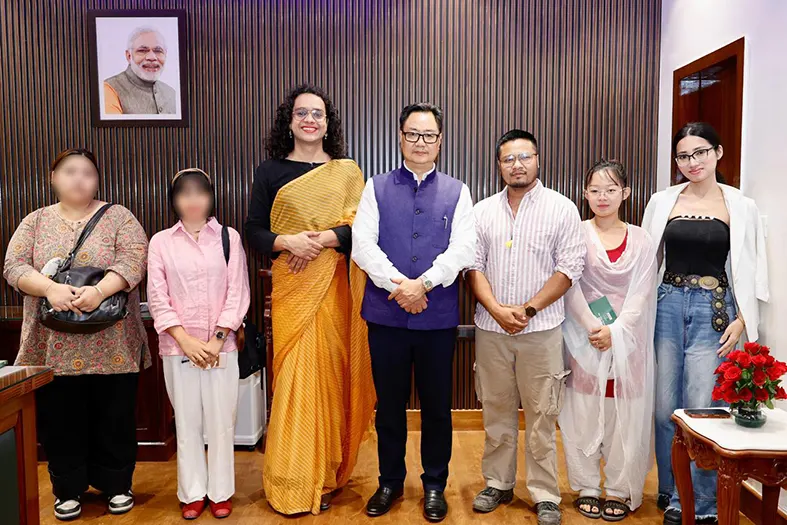
ITANAGAR, 28 Mar: A delegation from AP QueerStation Arunachal, accompanied by representatives from various Northeastern states, met union minister Kiren Rijiju in Delhi on Friday to present concerns regarding the Transgender Amendment Bill 2026.
The delegation consisted of six members, who raised concerns over the status of socio-cultural transgender identities in the Northeast, including those that are recognised, such as nupi manbi and nupa manba, and those that remain unrecognised, including identities from Arunachal Pradesh such as mumbal, mumbar, lapi, shokho, and others.
Concerns were also raised regarding transgender persons who already possess TG cards but do not fall within the socio-cultural categories being recognised.
The delegation highlighted challenges related to documentation, particularly for individuals who have obtained DM certificates within binary categories but whose other documents remain inconsistent. They pointed out that mismatches across Aadhaar, voter ID, and educational certificates are common, especially for those who transitioned before the Act, and sought clarity on how such realities would be addressed.
Serious concerns were raised regarding vague criminalisation provisions in the bill. The delegation questioned who would be criminalised under terms such as ‘allure’, and whether this could extend to supportive parents, family members, and service providers, including doctors, lawyers, mental health professionals, teachers, NGOs, and shelter homes. They emphasised the need for clear written safeguards to ensure that transgender persons and their support systems are not criminalised.
The issue of NRC in Assam was also raised. The delegation highlighted that, despite the 2011 census recording over 11,000 transgender persons in Assam, transgender people were effectively excluded from the NRC process. They questioned how transgender persons, often estranged from their families and lacking documentation, would prove lineage, and raised concerns about the implications if similar processes are implemented nationwide.
The delegation further highlighted that many transgender persons do not belong to any socio-cultural identity groups such as gharanas, and instead live and work independently or within informal collectives and support systems. Concerns were raised regarding their recognition under the current framework.
Voting rights were also discussed. The delegation pointed out ongoing challenges with document mismatches affecting voter identification. The delegation also highlighted the systemic lack of awareness among officials regarding transgender rights and legal protections, including the NALSA judgement.
The delegation also presented letters from the Arunachal Pradesh Psychological Association, Human Rights Association, North East Human Rights, Oju Welfare Association, and AP QueerStation, along with evidence-based research conducted with Bridge India. They spoke about their work on the ground, including addressing mental health crises and suicides among transgender persons in Arunachal. The delegation highlighted the suicide of a transgender woman in Pasighat and expressed concern over the rising vulnerabilities faced by the community.
The delegates said that they had come with the expectation that the minister would take their concerns to higher authorities and intervene. “However, the minister repeatedly advised the delegation to approach the courts, stating that justice would be delivered through judicial processes,” the AP QueerStation said in a release.
The delegates responded by highlighting that the NALSA judgement itself was achieved through the courts, and that subsequent legislation had been enacted by the government. They expressed concern that returning to litigation would require significant time and resources, which grassroots collectives and support groups do not possess, and questioned the impact of prolonged legal battles on their lives.
The delegation also raised concerns regarding the claim that the bill had undergone extensive consultation. They pointed out that members of the National Council of Transgender Persons had publicly stated that they, as well as representatives from the Northeast, were not consulted. “The minister stated that he was not aware of this and reiterated that the matter falls under the jurisdiction of the ministry of social justice and empowerment,” the release stated.
The delegation attempted to highlight the intersection of transgender issues with tribal and indigenous identities in the Northeast. However, the minister maintained that the issue did not fall within his department and reiterated that the delegation should approach the ministry or courts concerned.
The delegation said that their concerns, lived realities, and requests for intervention were not adequately addressed during the meeting.
“The delegates said that they felt hurt and unheard. During the meeting, the minister asked whether they had read the bill. The delegates responded that they had. The minister then stated that he himself had not read the bill,” the release claimed.
The delegation also highlighted the racist nature of the bill and its impact on tribal and indigenous transgender identities in the Northeast. They pointed out that the bill fails to acknowledge these identities and instead centres only certain North Indian identities such as hijra and kinnar, effectively excluding and criminalising others.
“Despite these concerns being raised, the minister did not offer support or intervention, including in his capacity connected to tribal and minority concerns,” the release stated.
The delegation concluded by placing on record a broader set of concerns emerging from community voices, including those articulated by Sawang Wangchha of AP QueerStation.
These concerns highlight that the transgender amendment bill is not merely exclusionary but poses a serious threat to indigenous, tribal, and Northeastern identities as a whole. “The bill attempts to narrow transgender identities into limited socio-cultural categories such as hijra and kinnar, which do not represent the lived realities of many communities in the Northeast. Identities such as mumbal, mumbar, lapi, shokho, nupi manbi, nupa manba, and many other indigenous identities risk erasure under this framework,” the release said.
The delegation emphasised that this is not just a transgender issue but an issue of cultural survival, identity, and dignity for indigenous and tribal communities. A law that imposes mainland-centric definitions of gender reinforces existing hierarchies of race, culture, and power, and deepens marginalisation of Northeastern people who already face systemic discrimination, it said.
“These concerns were placed before the minister. However, the delegation noted that Rijiju did not respond to these questions and repeatedly directed the delegation to approach the courts or other ministries,” it added.
The meeting concluded with the delegation reiterating the need for accountability, clarity in the law, protection from criminalisation, and meaningful inclusion of transgender voices in policymaking by truly listening to their voices and making them part of welfare processes, the release said.