Book Review
The Anatomy of My Soul
Chaong Rangjang
Notion Press, 2026
Pp.77
Price: 295
[ Dr Yater Nyokir ]
Despite presenting itself as an age of freedom and comfort, the modern world remains shaped by invisible constraints of emotional disconnection, isolation, and unspoken expectations. Individuals may appear independent, yet they continue to carry the weight of social and psychological pressures. As Jean-Jacques Rousseau famously wrote, “Man is born free, and everywhere he is in chains.” These chains are often formed by fear of judgement, expectation, and responsibility, which prevent individuals from living their lives on their own terms and from fully expressing themselves. This idea still resonates today, as individuals continue to find themselves confined within emotional, psychological, and social constraints.
It is within this tension that Chaong Rangjang’s debut collection, The Anatomy of My Soul, unfolds, exploring the inner conflict of identity dissolution and the search for selfhood.
The book is structured into five sections: Prologue, Genesis, Interlude, The Blues, and Epilogue, each contributing to a deeply introspective body of poetry. Together, they trace a psychological and emotional journey, mapping the contours of an unsettled identity and human condition. Through raw language and recurring motifs, the collection engages with questions of belonging, selfhood, and existential endurance.
What distinguishes Rangjang’s work is not merely its engagement with emotional inarticulacy – an inability to express desire, identity, and pain that often culminates in existential crisis – but a sustained effort to portray this inner turmoil as a lived, continually evolving process.
The closing movement of The Anatomy of My Soul ultimately turns not towards resolution, but towards survival through imagination. This is especially evident in the poem ‘Dream’, where the speaker confesses:
“Dream, my only possible escape
Without it, maybe
I’d have been long gone
It is my safe space.”
After a collection marked by silence, emotional exhaustion, and repeated encounters with inner collapse, this moment does not offer healing in a conventional sense, but something subtle and more fragile, a space to exist without judgement. It reinforces the central insight of the collection: while reality remains harsh and unresolved, imagination, writing, and dreaming become ways of enduring it. This is further echoed in ‘What is poetry?’, where the speaker describes poetry as both necessity and refuge:
“Poetry is the fire, and poetry is the wind.
Poetry quenches my thirst
It is the necessity
For me to exist in this moment
In this life
Poetry is the home
It’s the home of my soul.”
In this sense, Rangjang’s work does not attempt to overcome existential burden, but to live with it honestly, leaving readers with the recognition that survival itself can become a meaningful form of resistance.
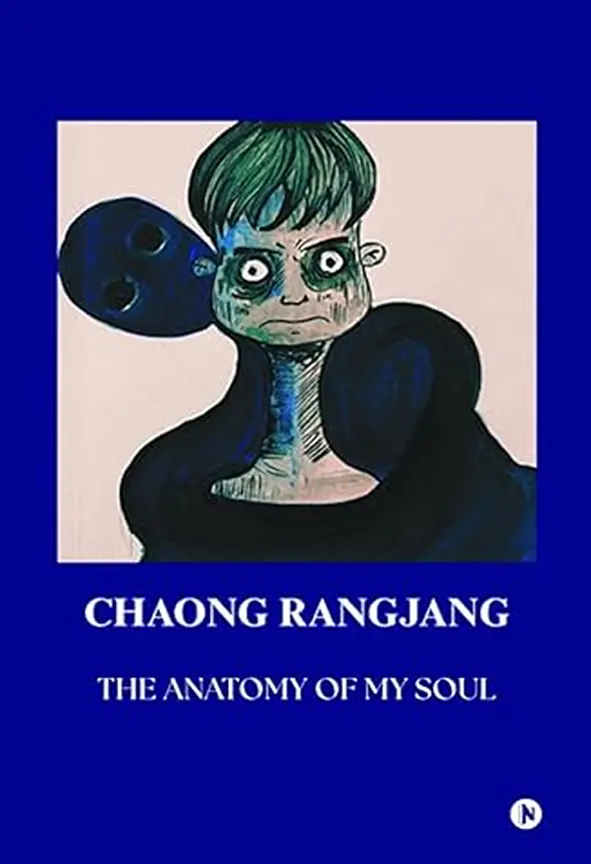
The collection is further enriched by a series of surreal illustrations that accompany the poems, functioning not merely as striking visual additions but as integral extensions of the text. These illustrations deepen the emotional and psychological landscape of the work, offering an arresting visual counterpart to the verse. By depicting distorted forms, fragmented figures, and dreamlike scenes, the illustrations evoke what remains unspoken in the poems. Together, the interplay of illustration and verse intensifies the reader’s engagement, reinforcing the poet’s exploration of inner conflict and fractured identity.
Taken together, Rangjang’s The Anatomy of My Soul offers a compelling exploration of the failure of self-expression and identity as an ongoing, unresolved process. Through its movement from existential rejection to fragile modes of survival, the collection foregrounds the difficulty of existence while affirming the resilience required to endure it. It does not resolve the tensions it presents; instead, it sits with them, suggesting that meaning lies not in resolution but in the act of continuing to live and move forward. (Dr Yater Nyokir is an independent scholar and a member of the Arunachal Pradesh Literary Society)