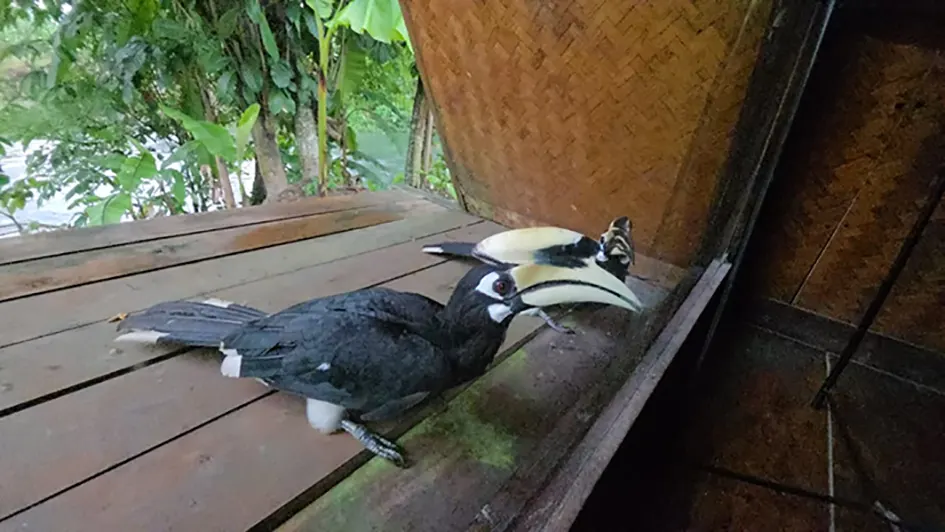
NAMSAI, 27 Apr: A rare and unusual mirror-induced behaviour by a pair of oriental pied hornbill (Anthracoceros albirostris) was reported from a resort here.
Dr Tilling Tayo, a veterinarian, witnessed the rare occurrence during an early morning stay at the resort.
Dr Tayo said he witnessed the birds at around 5:50 am on 26 April, when he was awakened by repeated tapping sounds on the glass wall of his room.
“Initially, I thought two birds were fighting. But on closer observation, it became clear that the hornbills were actually striking their own reflections on the glass surface of the room wall,” Dr Tayo said.
The room’s glass panel, though transparent from inside, appeared like a mirror from outside. This caused the hornbills to mistake their reflections for rivals, triggering aggressive behaviour. The confrontation continued for about an hour, after which Dr Tayo, concerned for the birds’ safety, opened the door and gently chased them away.
Experts say such mirror-induced aggression is commonly observed in domestic birds, but is seldom documented in wild hornbills, making the observation noteworthy.
A fruit-bearing tree located behind the resort’s rooms has been identified as the main attraction point for the hornbills and other bird species. As the birds visit the tree, they encounter their reflections in the glass and react instinctively. This combination of food availability and reflective surfaces appears to be the key factor behind the behaviour.
The incident highlights how human-made structures can unintentionally influence wildlife behaviour, offering rare opportunities for observation, while also underscoring the need for wildlife-sensitive infrastructure design.
As Namsai quietly gains attention for this unique occurrence, the event serves as a reminder of the rich biodiversity of Arunachal Pradesh and the unexpected ways in which nature reveals itself.
Visitors interested in witnessing the phenomenon are advised to book Room No 102, which offers a particularly close view during the early morning hours. Observers describe the experience as akin to securing a ‘lucky seat’ – much like seat 11A on a flight, often referred to as a ‘miracle seat’ or ‘lifesaving seat’ – where a rare and unforgettable moment unfolds right before one’s eyes.
In a lighter vein, Dr Tayo has dubbed Room No 102 “Hornbill Knocking Room.”
The species is listed as least concern under the IUCN Red List (2020). Despite its stable status, conservationists emphasise its crucial role in seed dispersal and forest regeneration.