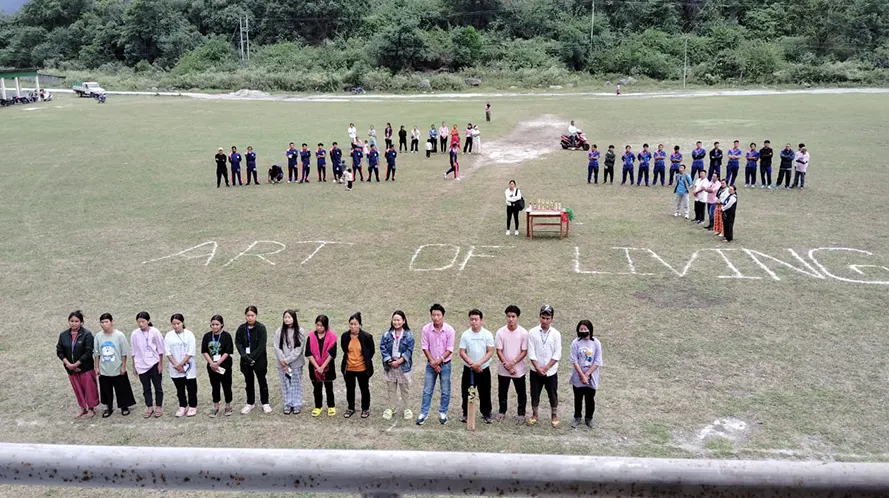
When Lemchun Wangpan returned from a stress-management workshop conducted by The Art of Living for police personnel in Arunachal Pradesh, he found himself reacting differently to the pressures of daily life. “Mera mann hi badal gaya (My mind has changed),” he said.
The programme, held across Namsai, Mahadevpur, and Chongkam, was part of a larger initiative by the global spiritual master and humanitarian leader, Sri Sri Ravi Shankar and The Art of Living to bring mental wellbeing practices to those working in high-pressure environments. For many police personnel in the state, the workshops offered something practical – better sleep, calmer responses, and the ability to carry out demanding responsibilities with greater clarity.
A ubiquitous challenge that modern society grapples with is high levels of stress. What is stress? “Stress is simply too much to do, too little time, and not enough energy to do it,” Shankar explains. “We cannot always reduce our workload or add more hours to the day. But we can increase our energy levels. When we have a lot of energy, the tasks don’t seem daunting or overwhelming.”
“Inner peace alone can ensure outer peace,” Shankar says. When one experiences peace within, the heart opens up, and one is more willing to take up bigger responsibilities for oneself and society. This is the secret behind The Art of Living’s vast network of inspired volunteers present in over 182 countries. The organisation’s humanitarian initiatives, breath, meditation and stress-relief programmes have touched over a billion lives in the last four and a half decades.
In Arunachal Pradesh, The Art of Living’s outreach has spanned classrooms, prisons, border villages, and administrative institutions, carrying programmes and support into some of the state’s most inaccessible regions.
For Tamune Miso, assistant deputy commissioner, the value of such programs lies in their practical impact. At the inauguration of one stress-management workshop, he encouraged more police personnel to participate so they could “perform their duties with a stress-free mind and healthy body.”
Some of the organisation’s most challenging work in Arunachal has unfolded in some of the most inaccessible regions.
In Jhomme village in Kra Daadi district, nights were once marked by near-total darkness. Reaching the village itself required crossing rivers without bridges and navigating difficult mountainous terrain. When The Art of Living’s solar electrification project began there under the Sri Sri Rural Development Programme (SSRDP), transporting equipment became an exercise in ingenuity and persistence. Volunteers packed solar equipment inside dry grass to protect it from moisture during transit. In places where vehicles could go no further, iron pulleys and wires were used to move materials across rivers.
Today, homes in the village are lit by solar power.
“Our village used to be in darkness,” recalled village head Gichik Tania. “Now we can move around at night.”
Under the Border Villages Development Programme, The Art of Living worked with the Arunachal government and the Arunachal Pradesh Energy Development Agency to instal solar systems in several remote villages. Individual homes received solar power packs, while schools, police stations, health centres, and government offices were equipped with solar lighting.
But the intervention did not stop at electrification.
Local youths were trained to maintain and repair the systems through self-help groups such as Arun Urja, effectively creating a generation of rural solar technicians within the villages themselves. Some families were also trained in mushroom cultivation and livelihood generation, helping communities build local economic resilience.
In border regions where migration among young people remains a growing concern, such initiatives have created reasons for many to stay back and contribute locally.
Through its ‘Light a Home’ initiative, The Art of Living has expanded rural solar electrification efforts across several Indian states, touching more than 1.65 lakh lives. Thousands of rural youths have also been trained in renewable energy skills.
In Lumla, close to the borders of Bhutan and China, the imposing campus of the Eklavya Model Residential School rises unexpectedly against the Himalayan landscape. Built in collaboration between the Ministry of Tribal Affairs and The Art of Living, the CBSE-affiliated institution brings modern educational infrastructure to a region where quality schooling was once difficult to access.
The school boasts of digital classrooms, audiovisual learning tools, meditation, martial arts, yoga, and value-based education.
The goal is not merely to achieve academic performance. It is to offer a more holistic model of education that allows students to remain rooted in their culture while preparing for a rapidly changing world.
That mission extends to the Sri Sri Ravi Shankar Vidya Mandir schools in Itanagar and Pasighat, as well. Here, students follow structured routines balancing studies, sports, meditation, and cultural learning. Alongside mathematics and science, children are taught environmental responsibility, non-violence, hygiene, and respect for local traditions.
The Art of Living has also collaborated with the Indian Space Research Organisation (ISRO) to support digital literacy initiatives in schools across Arunachal, helping bridge educational gaps in remote regions.
Across India, the organisation’s free schools now educate more than 1.2 lakh children in the remotest and most marginalised communities. The majority of the students are first-generation learners. Uniforms, transport, and meals help remove the economic barriers that often keep children, especially girls, away from classrooms.
What stands out in Arunachal is not a single large intervention but the cumulative effect of many sustained ones. Stress-relief programmes for police personnel; educational institutions in remote terrain; solar lighting in inaccessible villages; youth leadership training; programmes for prison inmates and former insurgents. Individually, each project addresses a different need, and together, they reflect a broader attempt to strengthen both inner resilience and community infrastructure.
Over the decades, Sri Sri Ravi Shankar’s humanitarian work has also extended into some of the world’s most difficult conflict zones, from facilitating dialogue with insurgent groups in India’s Northeast to engaging with FARC rebels and ending Colombia’s long civil war. His environmental initiatives have included rejuvenation of more than 75 rivers and tributaries, prison programmes, groundwater recharge projects, and large-scale reforestation drives.
For these efforts, Shankar has received numerous international honours, including the Padma Vibhushan, India’s second-highest civilian award. But in Arunachal, his legacy lies in each village that finally lights up after decades of remaining in darkness; a student learning to code up in a Himalayan village; a young technician finding work within his own community; or a policeman discovering calm amid relentless pressure. (PR by The Art of Living)