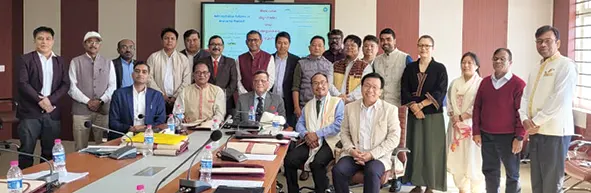
RONO HILLS, 6 Dec: A workshop on Administrative Reforms in Arunachal Pradesh was held at the Rajiv Gandhi University (RGU) here on Friday, marking the first-ever collaboration between Rajiv Gandhi University and the Administrative Reform Commission of Arunachal Pradesh. The initiative was aimed at building a structured academic-administrative partnership to support policy reforms and strengthening institutional governance in the state.
Speaking on the occasion, RGU registrar Dr. N.T Rikam congratulated the state government for establishing the Administrative Reform Commission with a progressive vision. He expressed RGU’s full commitment to providing academic expertise and support to the Commission in all possible ways.
Commissioner to the Governor Pawan Kumar Sain highlighted the importance of both top-down and bottom-up approaches to administrative reform. Citing his experience in Tezu, he recalled how the process of issuing ST certificates once took nearly six months, creating immense hardship for people from interior regions. The introduction of Jan Suvidha in 2006 brought this down to a single day, becoming a model later adopted across Arunachal Pradesh. He emphasized that such proactive initiatives significantly enhance public access to government services and strengthen institutional efficiency.
RGU vice chancellor prof. S.K Nayak spoke on the need for all laws in Arunachal Pradesh to reflect the state’s unique socio-cultural and geographical landscape. Describing Arunachal Pradesh as a melting pot of cultural diversity with added strategic challenges due to its international borders, he shared his experiences of working with various administrative bodies. He underlined the importance of industrial development to generate employment and revenue and expressed hope that the workshop’s deliberations would pave the way for solutions tailored to the distinctive needs of the state.
(Retd.) Chairman of the Administrative Reform Commission Pramod Jain elaborated on the mandate of the Commission and highlighted the importance of collaboration between academia and administration in designing effective reforms. He emphasized the need for continuous training and re-training of officers and stressed that the primary purpose of any law must be to simplify procedures and improve service delivery. He suggested that certain departments could be merged for better coordination and efficiency and that new laws must be framed wherever regulatory gaps exist. He also discussed the Public Private People Participation (PPPP) Model, which envisions the community as an active stakeholder in governance, thereby strengthening participatory administration.
The technical session that followed featured detailed presentations by various committees of RGU on themes such as the organizational structure of the government of Arunachal Pradesh, gender equality and inclusion in recruitment and promotion, social capital and participative service delivery, promotion of e-governance, refurbishing personnel administration, and ensuring effective district administration. Each presentation was followed by an in-depth discussion, with members of the Commission engaging actively through questions, clarifications, and suggestions. All recommendations were carefully noted with the aim of incorporating them into the evolving framework of administrative reforms in the state.