[ Tongam Rina ]
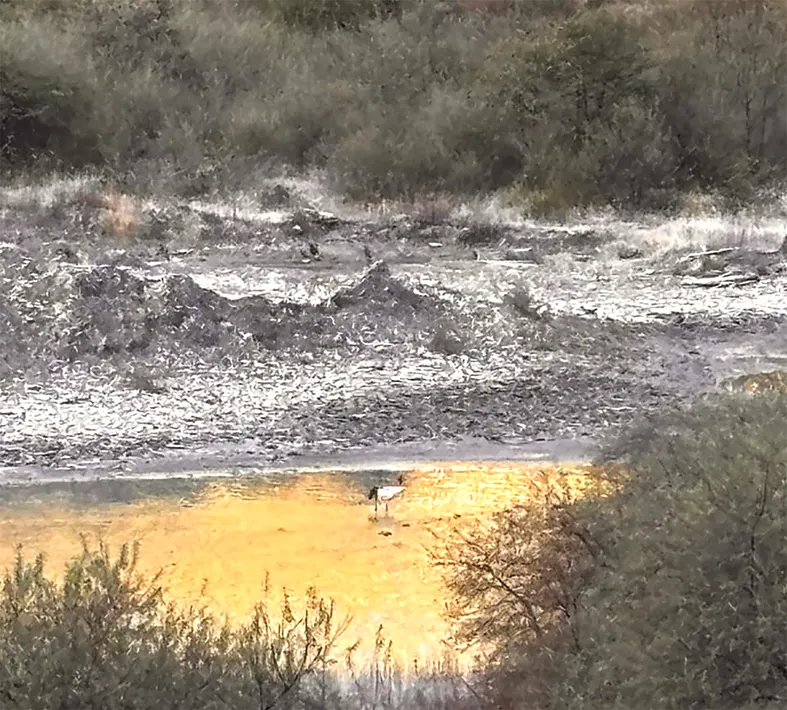
TAWANG, 10 Dec: A black-necked crane landed in Nyamjangchu, Zemithang in Pangchen Valley on Tuesday. A local said that the lone crane disappeared soon after landing due to habitat disturbance following mining in the area. WWF’s Pemba Tsering Romo said that the crane will likely return in few days if the villagers cease mining. They have been instructed by the administration not to quarry in the area after the crane landed on Dec 9.
Deewan Mara, APCS, executive magistrate, Jemeithang Circle, in an order issued today, has banned quarrying, stating that any violation of the same shall invite a penalty of Rs. 50,000 or legal action or both, as the black-necked cranes have started arriving at the Nyamjangchu river in Jemeithang.
The order said that the quarries and crusher have created an obstruction to its habitation, as he directed that “all those quarries/crusher along the river bank of Nyamjangchu, that there shall be no further quarrying along the river Nyamjangchu, is permitted for 45 days or till the black-necked crane will be in habitation at Jemeithang.”
With the landing of the crane in Zemithang, the state is now hosting two revered guests, as one had already arrived in Sangti valley in West Kameng on 30 November. The black-necked cranes travel all the way from Tibet to their wintering sites of Chug Valley, Sangti Valley and Pangchen Valley. The wintering sites, particularly Sangti and Zemithang have been severely disturbed because of river mining and construction activities.
In Zemithang, the 3-km stretch of the Nyamjang Chhu between Brokenthang and Zemithang is one of the two regular long-term wintering sites of the bird in India, but it is also the site of massive quarrying. On more than one occasion, the cranes have not landed even after they had come as far as their site.
Sangti has seen unprecedented concretisation near the wintering site and it has affected the cranes. The cranes did not land between 2009-2013 in Sangti Valley, as well as in 2017, though it has been adding gradually since then.
In 2018, the villagers had to intervene and stop paragliding activities by the National Institute of Mountaineering and Allied Sports (NIMAS), Dirang, between November-March, as it disrupted the landing of the cranes. The cranes did land once the gliding activities stopped.
But such short-term measures may not be the answer.
The arrival of cranes usually happens between late October to early April. However, locals say that birds have arrived later and are leaving earlier than they normally used to do due to the changing weather patterns, while habitat destruction is not making it easier for these birds.
According to a study conducted by RGU’s prof. Daniel Mize, “In Arunachal Pradesh, the wintering of the black-necked crane was first recorded in the Apatani Valley by F. N. Betts in 1946. He recorded 27 individuals – a number which remained constant and regularly wintered in the Apatani Valley till 1979. As per L. Kaecher’s report in 1981, the black-necked crane either abandoned the Apatani Valley or became extinct sometime in 1979. After that, the black-necked crane was rediscovered at Sangti Valley in 1990, then in Zemithang and Chug Valley in 2010 and 2016, respectively.” (Details here Will the black-necked crane winter again? | The Arunachal Times)
While Bhutan, another important destination for these revered birds, even as it faces pressure from infrastructure activities in wintering sites, has made several efforts to safeguard the sites. According to the Royal Society for Protection of Nature, Phobjika Valley, an important conservation area, is protected, and because of conservation efforts, there have been visible changes, including a change in status from Near Threatened to Vulnerable in the International Union for Conservation of Nature (IUCN) Red List.
The IUCN listed the cranes as Near Threatened in 2020, upgrading them from their previous Vulnerable classification. Even though the classification may have seen improvement, the wintering sites in Arunachal face unabated human interference.
With habitat destruction and no long-term effort to completely secure the habitats, these revered cranes of the Buddhist people, and the beloved crane of the 6th Dalai Lama, who was born in Mon Tawang, seem to be in a precarious position.
Apart from human interference, feral dogs remain a threat for these birds. Last year, a crane was left injured after being attacked by feral dogs in Chug Valley. The injured crane was subsequently relocated to Morshing village. Its partner had to leave the injured crane behind as it recuperated.
From high-tension wires, which have proved fatal for these cranes, to feral dogs to mining, as of now there seems to be no respite for these cranes.
The revered cranes may now have to look at the people and the govt to save their winter homes at Chug Valley, Sangti and Pangchen Valley.