[ Amar Sangno & Saraswati Gao ]
PASIGHAT, 2 Jan: Opum (name changed), a 21-year-old BA first-semester student at Jawaharlal Nehru College (JNC) in Pasighat, East Siang district, is hesitant to go back to the boys’ hostel after his winter break, as he’s left with no energy to go to bed on an empty stomach for the remainder of his semesters.
The story of students going to bed without dinner at JNC’s boys’ and girls’ hostels has spanned the last three decades, with no sign of improvement, despite all modern facilities being at the college’s doorstep.
The most ubiquitous articles in the hostellers’ rooms is an electric coil stove and packets of Maggie, as many students have survived countless nights throughout their semesters depending on these Maggie packets and an electric coil stove.
There are only two meals (breakfast and lunch) served at the boys’ and the girls’ hostels, and these two meals have become an ingrained culture at JNC, as no college administrator has ever attempted to improve the mess management, thus leaving the students at the mercy of wardens and prefects.
“The two-time meal culture has been around since our college days,” said Tapum Jamoh, the first general secretary of JNC (1964-68). However, during his time the student stipend was only 80 rupees and they contributed 40 rupees towards mess management. Jamoh was shocked to learn that this culture is still going on, even after four decades.
Reportedly, the 2018-21 batch of Indira, Sarojini and New girls hostels (I&II) had the worst experience, as they used to get only one-time meal.
“Even before I joined the college, I was well aware of the two-time meal culture in the boys’ hostel. So, we collect lunch in a hot case and sometimes save some of the lunch meal for dinner,” said another hosteller on condition of anonymity.
He added that every student has to buy an electric cooker and stock up on Maggie and vegetables for dinner, and they have a hard time studying during semester exams.
“Those who don’t have pocket money, they go to bed on an empty stomach,” he chuckled, taking the misery in stride. It is learnt that each session, the students demand three meals a day; however, it does yield any result.
Like the Trinamool Congress’ 2014 Lok Sabha election manifesto, ‘roti, kapda aur makan’ (food, clothes and shelter), serving three meals in the boys’ and girls’ hostels has always been a top agenda for each general secretary candidate in every academic session. Yet it remains unchanged.
The hostel wardens and the students blamed the cooks who, according to them, come at their whims and fancies. However, the cooks denied the allegation and claimed no strict instructions had ever been given to them by the college authorities.
On being reached for a comment, JNC Principal Dr Tasi Taloh said that the principal has a limited role in hostel mess management as the responsibility has been given to the warden and the prefect.
One of the boys’ hostel wardens admitted that this sorry state of affairs has been going on for the last two decades. He revealed that each hosteller has to pay Rs 1,200 per month for mess management; however, with the growing prices of commodities and vegetables, even the current mess fee is insufficient for two meals, he added.
It is also learnt that the students had taken the matter to the principal during 2022-23, demanding dinner to be served at the hostels. However, the situation remains unchanged.
The principal and the wardens have brushed off the responsibility of poor mess management and the auto-pilot mode of administration at the college, thus leaving the students’ hope shattered.
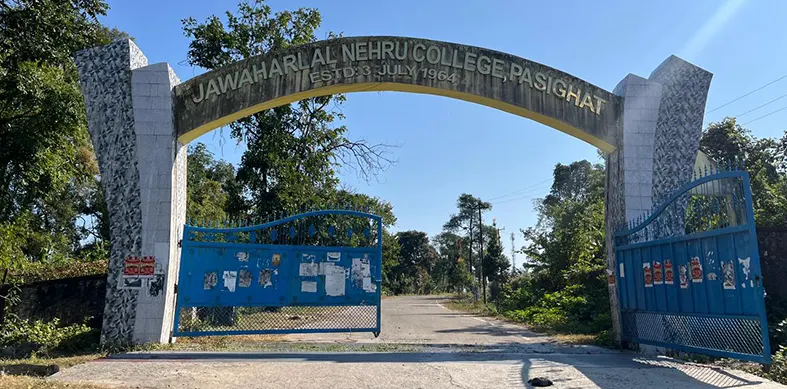
JNC is more or less a residential college. The college made its academic journey with just 42 students and eight faculty members in the arts stream at the barracks of the Assam Rifles on 3 July, 1964 and was shifted to its present site in 1967. There are nine hostels for boys and four hostels for girls.