ANINI, 3 Feb: Lisha Umpo, a young climate activist from Arunachal Pradesh and a member of the Idu Mishmi community, has successfully graduated from the NYCC (National Youth Climate Consortium) fellowship, marking a significant milestone for the state and the eastern Himalayan region.
She is also recognised as the first woman documentary filmmaker from the Idu Mishmi community, popularly known as ‘Idu filmmaker Lisha’.
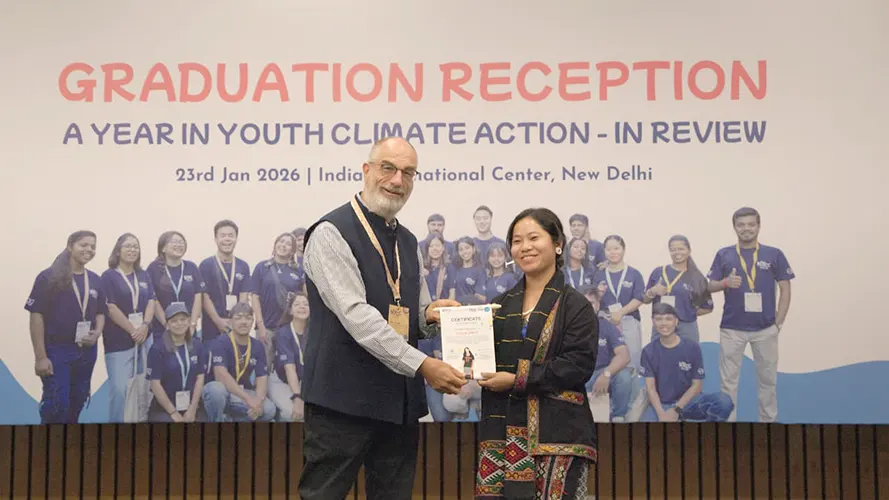
Umpo was the official representative of Arunachal and the only fellow selected from the state under the ‘climate change action’ category of the NYCC fellowship. She joined climate champions from 32 states and union territories at the NYCC graduation reception and exhibition held on 23 January at the India International Centre, New Delhi.
The event was attended by UNICEF India deputy representative Arjan de Wagt, and brought together experts and development-sector professionals from organisations including the UNDP, UN Women, World Bank, CDRI, The Climate Group, the embassy of Spain, and leading youth-led organisations. Fellows showcased decentralised, on-ground climate initiatives, demonstrating how local, community-driven solutions can generate national climate impact.
Umpo’s fellowship project, titled ‘Documenting indigenous medicinal plants of Dibang Valley’,focused on recording over 52 indigenous and native medicinal plant species from one of India’s most ecologically sensitive and biodiversity-rich regions.
The project documented traditional medicinal knowledge preserved by indigenous communities, highlighting the deep interconnection between cultural heritage, forest conservation, and climate resilience.
By centring indigenous wisdom in climate action, her work underscores the importance of community-led, nature-based solutions in addressing climate change. The documentation serves both as a conservation effort and as a living knowledge archive for future generations.
Notably, Umpo’s journey challenges conventional narratives of success.
A college dropout, she has continued to build her work through grassroots engagement, storytelling, and traditional knowledge systems. Alongside her research on medicinal plants, she is also actively engaged in traditional weaving, further strengthening her commitment to preserving indigenous culture, livelihoods, and identity.
Bringing the fellowship experience back to the community, on 2 February, Lisha presented her documentary film and project booklet during the central Reh festival celebrations in Anini, Dibang Valley. The screening and interaction sessions were held in the presence of MLA Mopi Mihu, whose continued support added significance to the dialogue on indigenous knowledge, culture, and climate action.
Reflecting on her journey, Umpo said: “Climate solutions already exist within indigenous communities, where forests are protected not just for survival but as living systems tied to culture, health, and identity.”
Building on her fellowship work, Umpo plans to establish a ‘living interpretation centre’ in Dibang Valley, envisioned as a platform for intergenerational learning, research, and community engagement. The centre aims to bring together elders, youths, researchers, and visitors to explore indigenous medicinal plants, traditional healing practices, and climate-linked cultural heritage.
Significantly, during the recent Cabinet Aapke Dwar programme held at Anini in Dibang Valley district, the state cabinet announced several key initiatives for the host district. Among the most important was the decision to establish a high altitude medicinal plant research centre, with a feasibility study to be completed within three months – a development that strongly aligns with Umpo’s work and reinforces the growing institutional recognition of indigenous knowledge systems.
Umpo’s journey stands as a powerful example of how youth leadership, indigenous knowledge, and community-rooted climate action can converge to create lasting impact-locally, nationally, and beyond.