ITANAGAR, 16 Feb: Participants from the Innovation Hub, Arunachal Pradesh Science Centre, State Council for Science and Technology (APSCS&T) represented the state at the North East Science Fair (NESF) & Innovation Festival (IF)-2026, held from 11 to 14 February at the National Science Centre in Assam’s Guwahati.
As part of the prestigious regional platformcelebrating scientific creativity and innovation, theteam showcased three innovative projects at the NESF.
While a project on sound visualisation was presented by Tinyo Sarah (Class 9) and Rei Zerjum (Class 9)from the APSC Innovation Hub, a project on smart restaurant automation was presented by ShalomNilling (Class 9) and Wennom Wangno (Class 9) from Exalt Foundation School, Itanagar.
A project on MFC power plant was presented by Takhe Mumpi (Class 9) from Sainik School, EastSiang district.
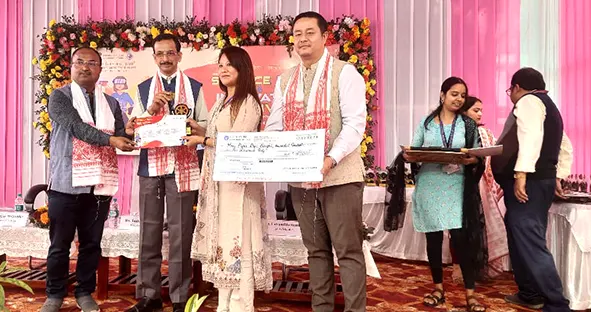
Adding pride to the state, Pura Papi Singhi, an innovator from the Innovation Hub, Arunachal Pradesh Science Centre, secured the 2nd prize at the innovation festival for her grassroots-level innovation titled ‘Automatic tazar maker’.
The participation provided an opportunity for students and innovators to showcase their ideas, interact with peers, and gain exposure through theregional science and innovation platform.
Meanwhile, the APSCS&T participated in the 21st national conference of heads of science museums held from 13 February at the Manaskhand Science Centre in Almora, Uttarakhand.
Organised by the Uttarakhand State Council for Science and Technology (UCOST), under the aegis of the National Council of Science Museums (NCSM), Kolkata, the three-day conference brought together directors and heads of science museums and centres from across the country, along with scientists, policymakers and distinguished delegates.
The conference, themed ‘Future of science museums & science centres’, focused on emerging roles of science museums, innovative science communication approaches, outreach in remote regions, inclusive public engagement, and the growing influence of artificial intelligence in science museum development.
Experts emphasised on transforming science museums into dynamic centres of learning, innovation and youth engagement.
The first technical session was co-chaired by APSCS&T Director CD Mungyak and Dehradun Science City adviser GS Rautela.
Mungyak presented the APSCS&T’s initiatives, highlighting experiential learning programmes of the Arunachal Pradesh Science Centre and Innovation Hub, including planetarium shows, robotics training, summer science camps and outreach activities such as the lab-on-wheels mobile science exhibition reaching 29 schools across the state.
The presentation also showcased youth innovation initiatives, grassroots technological innovation for livelihood development, support for local innovators, and the roles of CoE-BRSD, Kimin and the Patent Information Centre in promoting research and intellectual property awareness.
Arunachal Pradesh Science Centre Curator Vivek Kumar delivered a presentation on science communication activities, with special focus on dissemination of grassroots technological innovations for livelihood generation.
Four technical sessions were conducted during the conference, addressing digital and AI-driven exhibit designs, innovative communication models, and future-ready strategies to engage children and youthsin science.