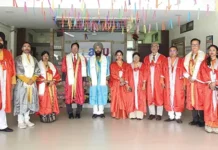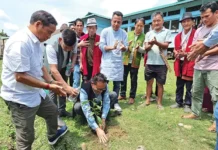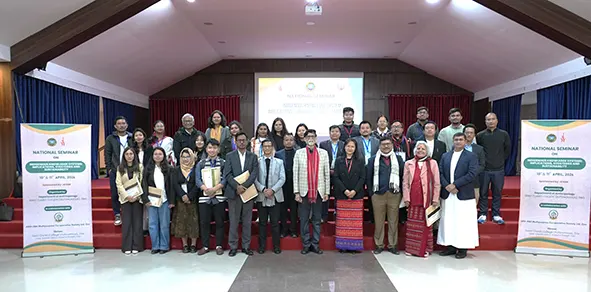
ZIRO, 11 Apr: Saint Claret College, Ziro (SCCZ) hosted a two-day national seminar on ‘Indigenous Knowledge Systems: Implications, Strategies and Sustainability’ on 10 and 11 April, during which scholars and researchers highlighted the complexity and depth of indigenous knowledge systems, particularly among tribal communities in Northeast India.
Participating in the seminar, Alipurduar University VC prof. Sarit K. Chaudhuri said that indigenous realities are inherently multi-layered, shaped by interwoven cultural, ecological, and historical dimensions.
Underscoring the institutional role in knowledge preservation, prof. Chaudhuri described museums as generators of ideas that can significantly contribute to revitalising indigenous traditions. He, however, cautioned that indigenous knowledge systems cannot always be preserved in their original or pristine form, especially when oral traditions are converted into written documentation. This transition, he noted, often leads to a form of oral fixity, potentially altering the fluid and dynamic nature of indigenous knowledge.
“Indigenous knowledge systems must be understood within its specific cultural and environmental context,” prof. Chaudhuri added.
On the concluding day of the seminar, prof. Nishamani Kar from Rajiv Gandhi University, reiterated and built upon the observations made earlier by prof. Chaudhuri.
Echoing his characterisation of museums as “generators of ideas,” prof. Kar stated that the role of museums and allied institutions cannot be undermined, describing them as vital spaces for generating ideas and preserving indigenous knowledge systems.
Prof. Kar appreciated that the research papers presented during the seminar avoided the romanticisation of indigenous knowledge systems, instead offering grounded and critical perspectives.
He highlighted the continued relevance of Mahatma Gandhi’s view in contemporary indigenous discourse, particularly in relation to sustainability and community-centric knowledge practices.
Further, he noted that the seminar reflected the spirit of trans-disciplinary research advocated by the National Education Policy, as seen in the diverse themes and methodological approaches of the papers presented. Commenting specifically on the paper ‘Walls with Feelings: Landscaping the Textual Décor of Itanagar,’ he stressed the importance of incorporating local languages in public signage and roadside communication, underscoring its role in cultural representation and identity preservation.
The seminar concluded with the announcement of the Best Paper Award, recognising outstanding research contributions presented during the sessions.
The Best Paper Award was conferred on Sonam Sultana Shah for her research titled ‘Streaming Sustainability: Ecofeminism, Indigenous Knowledge Systems, and the Representation of Women in Hindi OTT Web Series.’
Additionally, Outstanding Paper Presenter awards were given to Loder Dulley for ‘Tribal Epistemology and Apatani Oral,’ Lalhmingmawia for ‘Walls with Feelings: Landscaping the Textual Décor of Itanagar,’ Saepha Swamma for ‘Indigenous Food Practices and Cultural Continuity among the Sonowal Kacharis of Tinsukia District, Assam,’ and Janny Sukushi Toppo for ‘Transition in Indigenous Food Resources in Context of Food, Culture and Power.’
The awards were sponsored by AMA-ABA Multipurpose Co-operative Society Ltd. Ziro.
The seminar witnessed participation from scholars, researchers, and students, fostering academic engagement on the significance of indigenous knowledge systems in shaping sustainable futures.
The seminar was organized by the department of Anthropology with sponsorship from the Indian Council of Social Science Research, New Delhi in collaboration with AMA-ABA Multipurpose Co-operative Society Ltd.