[Dr Yater Nyokir]
In an age of glowing screens and restless scrolls, when the emerging generation stands increasingly unmoored from ancestral ground, literature becomes more than an art; it becomes an act of preserving the past and a space for reflecting on the future.
For the tribal communities of Arunachal Pradesh, where history has long travelled by word of mouth, songs, rituals, and landscape, literature carries the weight of memory, identity, and belonging. It gathers what is scattered by time and change, holding together fragments of oral tradition, lived experience, and indigenous ways of knowing that are at risk offading into oblivion.
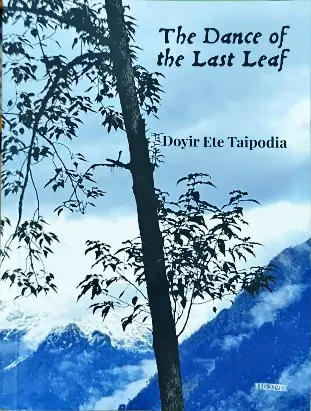
It is from this fragile yet resilient cultural terrain that Doyir Ete Taipodia’s debut work, The Dance of the Last Leaf, emerges. Rooted in the land, people, beliefs, and everyday rhythms of Arunachal, particularly the Galo community, the book transforms personal memory into collective witness. Taipodia’s verse does not merely describe a homeland; it listens to it, records its wounds and its wisdom, and legislates quietly through memory, language, and indigenous consciousness.
The anthology comprises 49 poems, broadly organised around the central themes of loss and survival, which recur across personal, cultural, historical, and social contexts. Poems such as ‘Lost Words’, ‘The Youngest’, ‘Past’, ‘Igi’, ‘Gomku’, ‘Shaman’, ‘Ai Agam’, ‘Mopin’, ‘Amin’, and ‘Our Journey’ draw inspiration from Galo folklore, cosmology, and faith. While rooted in traditional belief systems, these poems exercise poetic liberty, resulting in verses that are lyrical, intimate, and evocative. These poems carry the rhythms of theGalo’s oral storytelling while adapting them to contemporary poetic form.
Alongside this rootedness in tradition, the poet also captures the pulsating heart of Itanagar with meticulous attention to detail, evoking the city intimately in her poems. Much like Nissim Ezekiel’s iconic portrayal of Bombay, Taipodia does more than describe a place; she captures its rhythm, contradictions, and the intimacy of life within its spaces. In the poems ‘December’, ‘The Wall’, ‘City of Bricks’, and ‘Lady of the Meat Stall’, the poet transforms cityscapes into an assemblage of sensory and emotional experience. Taipodia stakes a claim for Itanagar as a city of poetic imagination, portraying a city that oscillates between rural roots and urban growth, concrete and bamboo, neon lights and natural hills. This oscillation becomes emblematic of a deeper tension: the struggle to hold on to heritage while simultaneously embracing modernity, reflecting a city and a society in constant negotiation between memory and modernity, tradition and change, and growth and loss.
In the poems ‘Not So Innocent’, ‘Crossroad’, ‘Why’, and ‘Fettered’, the poet shifts from observation to interrogation, probing the moral and ethical consequences of rapid socio-political and cultural change in Arunachal. Here, the human and the environment collide: corruption seeps into governance, spiritual and cultural moorings are displaced, and the natural world bears the scars of exploitation.
Conversely, poems such as ‘Tafrogam’ and ‘Anini’ celebrate the ecological and geographical splendour of Arunachal.
Taipodia also records the weight of history and colonial encounters. In the poem ‘The Hump’, she confronts the echoes of World War II in Arunachal, where American pilots perished flying over the treacherous terrains of Arunachal.
The anthology closes with ‘Old Villages’, one of the most moving poems in the collection. The poem captures a reality deeply familiar in Arunachal. The ‘Old Villages’ speaks of deserting villages that are slowly emptying as children leave home for opportunities, leaving behind lonely ageing parents to live with memories. The poem looks back with nostalgia, not to romanticise the past, but to grieve what is being lost in the rush towards modern life. Ending with a prayer to the ancestors, ‘Old Villages’ becomes both a farewell and a plea for remembrance, continuity, and a reconnection with the land, culture, and values that once held the community together.
Stylistically, the book is written in free verse and employs dense imagery, symbols, and layered metaphors. The deliberate use of lexical borrowing allows indigenous terms to remain untranslated, thereby preserving cultural specificity. This approach demands attentive reading but rewards it with emotional and intellectual depth.
In sum, Taipodia’s The Dance of the Last Leaf establishes a poetic universe that is both reflective and questioning. The poems portray a land caught between continuity and change, between human ambition and natural majesty. The book works not only as a mirror to society but also as a homage to the land itself, mapping its people, politics, and panoramas with equal care and lyricism. Throughout the collection, the poems move fluidly between the personal and the collective, the mythic past and the lived present, shaping a layered portrait of a land in transition, one that holds beauty and loss in the same breath. (Dr Yater Nyokir is an independent scholar and a member of the Arunachal Pradesh Literary Society, specialising in the literary tradition of Arunachal)