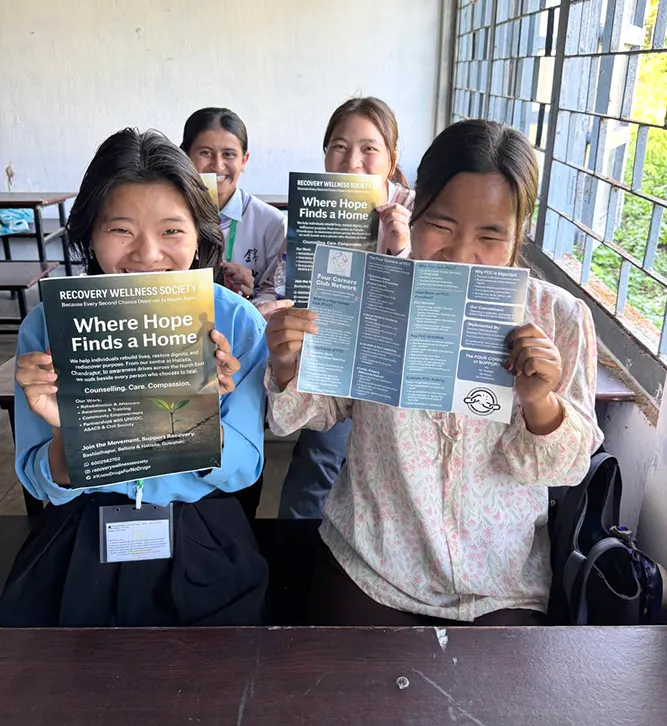
TEZU, 4 Feb: A two-day capacity-building workshop titled “Breaking the Chains of Addiction,” focusing on substance abuse, mental health, and the formation of the Four Corner Club Network in Arunachal Pradesh, was held on 3 and 4 February at Indira Gandhi Government College, Tezu.
The programme was organised by the Recovery Wellness Society in collaboration with the All Mishmi Women Welfare Society, Tezu, and the Department of Geography of the host college. Students, family members, teachers, social workers, and volunteers participated actively, reflecting strong community engagement with substance abuse and mental health concerns.
The workshop aimed to enhance awareness, reduce stigma, and strengthen understanding of addiction and mental well-being, while equipping participants with practical prevention, coping, and support strategies. Sessions addressed psychological, social, and health dimensions, with emphasis on early intervention, family involvement, and community-based care.
The programme was facilitated by the Recovery Wellness Society team led by its founder, Anupam Rohit, along with psychologists Deepshikha Kalita and Yeaija Choudhury, recovery coach Sagar Pradhan, and intern Jiri Kaling Riba. Participants were engaged through interactive discussions, experiential learning, and practical insights on recovery and mental health support.
A key outcome of the workshop was the formation of the Four Corner Club Network Core Committee, a community-driven platform comprising students, family members, teachers, social workers, and volunteers. The committee includes Soloi Ngadong (Gaon Burah, Tamla Nagar, Tezu), Mantilu Pul Tawsik (chairperson, All Mishmi Women Welfare Society), Dr. Rinkiolu Chai (assistant professor, Indira Gandhi Government College, Tezu), Senaso Yun (Digital Mishmi News), Sahina Dellang (student, Indira Gandhi Government College, Tezu), Paging Tayang (president, Bapu Welfare Society, Tafragam), and Anupam Rohit.
The Four Corner Club Network is envisioned as a sustainable platform to promote awareness, peer support, prevention, and community engagement on substance abuse and mental health across the region.
Mantilu Pul Tawsik appreciated the initiative and praised its timely focus, assuring continued support from the All Mishmi Women Welfare Society through future awareness and community activities.
Anupam Rohit highlighted that collective efforts by students, families, educators, social workers, and volunteers are essential to address addiction and mental health challenges through shared responsibility and sustained community action.
Dr. Rinkiolu Chai commended the academic and community-oriented approach of the programme and emphasised the role of educational institutions in prevention and student engagement, assuring continued institutional support.
Soloi Ngadong underscored the importance of community leadership in prevention and recovery and assured support from the village administration.
Participants shared experiences and committed to applying the learnings within their communities. The programme concluded with certificate distribution and a collective pledge to promote awareness, recovery, mental well-being, and a stigma-free society.