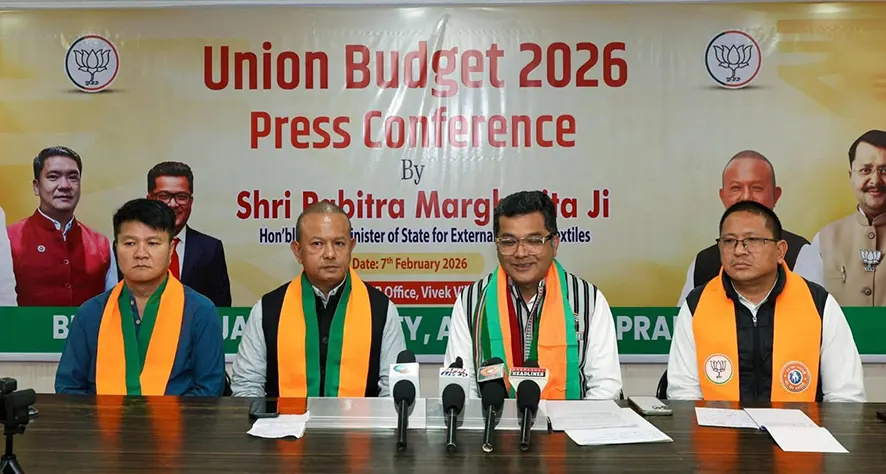
ITANAGAR, 7 Feb: Union Minister of State for External Affairs and Textiles Pabitra Margherita highlighted the key features of the Union Budget 2026-27 and the Centre’s development initiatives and allocations for Arunachal Pradesh at a press conference here on Saturday, a state BJP release said.
Margherita said that the budget focuses on several transformative initiatives aimed at economic growth, infrastructure development, social inclusion, and regional empowerment, reflecting the government’s commitment to inclusive growth and sustainable development.
He said that the Centre has given a renewed focus on sports development through the Khelo India Mission to nurture sporting talents and transform India’s sports ecosystem over the next decade.
For rural economic growth, he said, a loan-linked capital subsidy scheme has been proposed to establish private veterinary colleges, hospitals, and diagnostic laboratories.
“Integrated development of 500 reservoirs and amrit sarovars has been proposed to boost fisheries and rural livelihoods,” he said. The minister said that to promote women entrepreneurship, self-help entrepreneur (SHE) marts will be established as community-owned retail outlets, supported by Rs 10,000-crore SME growth fund.
Under the Divyangjan Kaushal Yojana, he said, targeted skill development will be provided in sectors such as IT, AVGC (animation, visual effects, gaming, comics), hospitality, and food and beverage industries.
The government will develop city economic regions (CERs) based on specific growth drivers with an allocation of Rs 5,000 crore per CER over five years, the minister said.
He said that the budget introduced several landmark initiatives for the Northeast, which include development of Buddhist circuits across Arunachal and other Northeastern states to preserve heritage sites, enhancement of connectivity, promoting pilgrimage tourism, supporting cultivation of agarwood and high-value nuts such as almonds, walnuts, and pine nuts to strengthen rural livelihoods, and introduction of a pilot programme to train 10,000 tourist guides across 20 iconic tourist destinations through a 12-week hybrid training programme in collaboration with IIMs, benefiting Northeast’s tourism potential.
Key allocations for Arunachal include Rs 20,666 crore as tax devolution, Rs 43,197 crore as grant-in-aid, and special assistance for capital expenditure through interest-free loans to strengthen infrastructure development.
Margherita said that Rs 7,654 crore have been released to Arunachal since 2020-21 under capital expenditure support schemes.
“These allocations will help build roads, bridges, schools, healthcare facilities, and strategic infrastructure, ensuring inclusive development even in remote border villages,” he said.
The minister said that Arunachal is being developed as a national hub for clean hydropower. The installed hydropower potential in Arunachal now exceeds 1,500 mw, he said, adding that projects in the Siyom sub-basin, worth over Rs 3,700 crore, are underway.
He further stated that 12 stalled hydropower projects have been revived with an investment of Rs 1.26 lakh crore.
The minister said that over 850 kms of national highways (NH) have been built since 2014, increasing the total NH length to over 4,300 kms. He further said that the Naharlagun railway station is being modernised under the Amrit Bharat Scheme.
Additionally, 455 villages in Arunachal are being developed under the Vibrant Villages Programme, he said.
The minister said that Rs 5,279 crore has been allocated to the textiles ministry in the union budget. He said that an integrated programme for the textile sector has been launched, focusing on the National Fibre Scheme for Self-reliance in Fibres, Textile Expansion and Employment Scheme, National Handloom and Handicraft Programme, Tex-Eco Initiative for Sustainable Textiles, and Samarth 2.0 for advanced textile skilling.
The Mahatma Gandhi Gram Swaraj initiative will strengthen khadi, handloom, and handicrafts through branding, skilling, quality improvement, and global market linkages, supporting rural livelihoods and the ‘one district, one product’ initiative, he said.
The minister said also that “mega textile parks” will be established to provide integrated infrastructure, enhance scale efficiencies, and promote value addition, including growth in technical textiles.
To boost textile exports, the export obligation period has been extended from six months to twelve months for exporters of garments, leather products, and footwear, improving compliance flexibility and working capital management.
He expressed hope that Arunachal and the entire Northeast would play a crucial role in India’s journey towards becoming a developed nation by 2047.