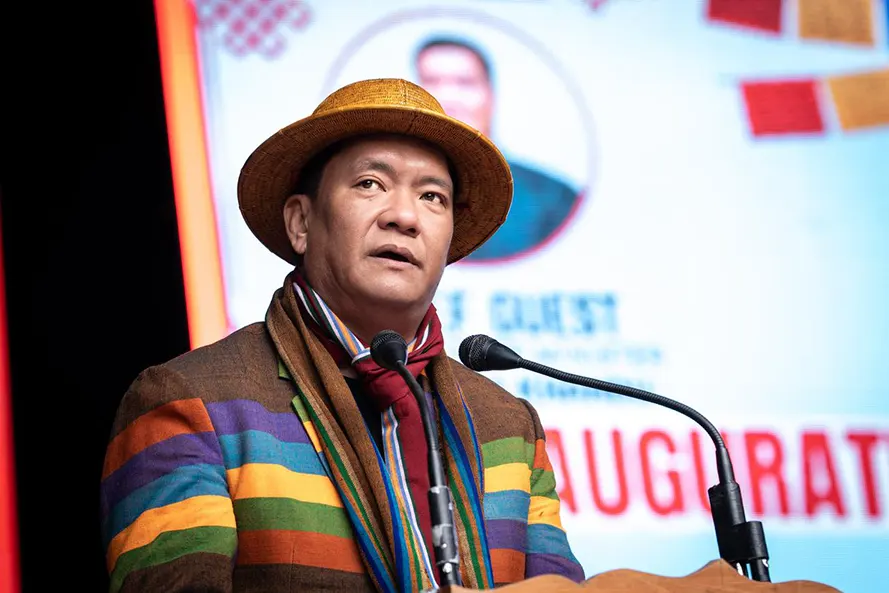
TAKSING, 9 Feb: Chief Minister Pema Khandu reaffirmed the state government’s commitment to accelerating development, connectivity and livelihood opportunities in frontier areas of Arunachal Pradesh.
He said this after inaugurating the Tsari Taksing Gajang Shedup Dargeyling monastery in Taksing, a remote border village in Upper Subansiri district, abutting the Tibet-China region, on Monday morning.
Addressing a large gathering, the chief minister described the event as historic, noting that such a massive public congregation was being witnessed for the first time in Taksing’s history. He lauded the Nah Welfare Society, the local leadership, and the district administration for organising the programme despite logistical challenges posed by the region’s remoteness.
Khandu said that more than 40 developmental initiatives, including inaugurations and foundation stone laying, were undertaken in the area, which falls under the Nacho assembly constituency, during the visit, reflecting the pace of infrastructure growth in the district. He said the transformation witnessed across Arunachal over the last decade is the result of collective efforts of the state government, elected representatives, officials and central agencies under the leadership of Prime Minister Narendra Modi.
Highlighting connectivity as the backbone of development, Khandu recalled that Taksing was once accessible only by helicopter due to the absence of roads. He said that road connectivity to the area was achieved in 2019 after sustained coordination with the Government of India and the Border Roads Organisation (BRO), marking the beginning of socioeconomic transformation in the region.
Referring to the Trans-Arunachal Highway, the chief minister said that the nearly 1,800-km corridor, stretching from Tawang to Longding, has significantly reduced travel time and improved access to district headquarters across the state. He cited examples of districts where journeys that once took over 12 hours can now be completed in about five hours.
The chief minister also spoke about the upcoming Frontier Highway, a strategic border road project approved by the Government of India. He informed that tendering is underway in multiple stretches, including Sarli-Taliha and Taliha-Tato segments in Upper Subansiri district, and sought public cooperation to ensure smooth and transparent implementation.
Emphasising on zero tolerance towards corruption, Khandu warned that delays or irregularities in land compensation and project execution would harm public interest. He cited action taken in certain eastern stretches of the Trans-Arunachal Highway, where investigations were initiated and strict measures enforced to ensure accountability.
On border area development, Khandu said that the Vibrant Villages Programme, launched from Arunachal in 2021, has brought significant benefits to frontier regions by improving road connectivity, livelihood options and basic infrastructure. He highlighted the importance of coordination between civil administration, the Indian Army and the ITBP to build sustainable models of development in border villages.
He announced that Taksing would be taken up as a tourism circuit, particularly in view of its historical and religious significance in Buddhism. He said Taksing is a sacred pilgrimage site associated with the ancient Tsari (Rong Kora), which attracted pilgrims from Tibet and other regions until the mid-20th century. Efforts are underway, in consultation with the Army and the Government of India, to revive the pilgrimage in a regulated manner.
Referring to Arunachal’s hydropower potential, Khandu said the state is emerging as the country’s leading hydropower hub, with nearly 19,000 mw of capacity under various stages of development. He said projects such as the 2,000 mw Lower Subansiri project are nearing completion, while several other mega projects will further strengthen the state’s economy.
He urged local communities to support hydropower development, highlighting the benefits of employment, land compensation and the newly announced policy under which 1 percent of power sale revenue will be directly transferred to affected families through DBT, in addition to allocations under the local area development fund.
The chief minister also assured that issues raised in a six-point memorandum submitted by the Nah Welfare Society, including road connectivity, water supply and tourism infrastructure, would be examined and addressed through a dedicated project for Taksing and Kodoka areas.
Reiterating the government’s grassroots governance approach, Khandu said that initiatives such as SevaAapke Dwar, Sarkar Aapke Dwar, and Cabinet Aapke Dwar have brought governance closer to the people, benefiting over 15 lakh citizens so far. He announced that once basic infrastructure improves, a Cabinet Aapke Dwar meeting will also be held in Taksing.
Calling upon newly elected panchayati raj representatives to play a proactive role, the chief minister stressed the importance of transparency, convergence of schemes and people-centric planning under programmes like the Viksit Bharat Gram Yojana, with focus on water security, infrastructure, livelihoods, agriculture, tourism, and employment generation.
He expressed confidence that Upper Subansiri district, with collective effort and public participation, would emerge as a model of development, tourism and border area resilience in the coming years. (CM’s PR Cell)