VC stresses responsible AI adoption
RONO HILLS, 11 Feb: Rajiv Gandhi University (RGU) vice-chancellor prof. S.K Nayak emphasized the need for responsible Artificial Intelligence (AI) adoption and encouraged students and faculty members to actively engage with emerging technologies.
Participating in a pre-summit event of the AI Impact Summit 2026 on Tuesday, prof. Nayak highlighted the transformative potential of AI in reshaping higher education, governance, and research ecosystems.
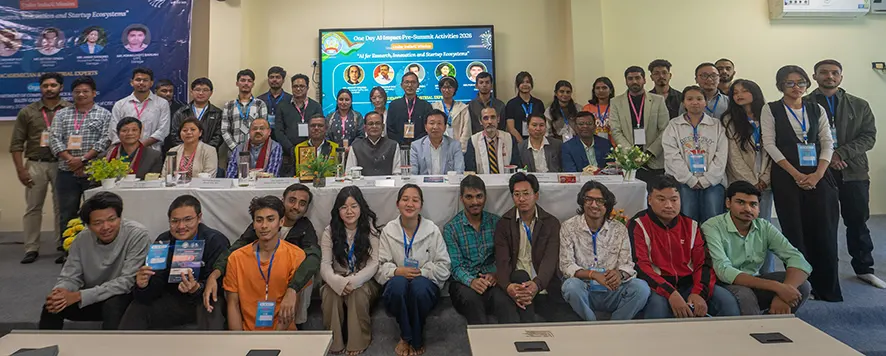
The event, organized by RGU’s computer science and engineering department, brought together academics, industry experts, technology professionals and students from institutions across Arunachal Pradesh and Assam to discuss the expanding influence of AI on research, innovation, start-ups and governance.
RGU registrar Dr. N.T Rikam emphasized the importance of institutional preparedness in integrating AI-driven systems into administrative and academic frameworks. He stressed the role of structured policies and capacity-building initiatives to ensure ethical and effective implementation.
The university’s IQAC director prof. Utpal Bhattacharjee spoke on quality benchmarks and the relevance of AI in strengthening academic processes, data-driven decision-making, and institutional accreditation standards. He noted that AI-enabled systems can significantly enhance transparency, efficiency, and performance monitoring.
Dean of the faculty of engineering and technology prof. Marpe Sora elaborated on the importance of interdisciplinary collaboration and embedding AI components within the curriculum. He encouraged research-driven learning and stronger industry-academia engagement.
Head of department of computer science and engineering Ani Taggu stated that the pre-summit was intended to sensitise students and faculty at an early stage to emerging AI technologies, with particular emphasis on skill development, interdisciplinary engagement, and region-specific problem-solving.
He noted that such initiatives would contribute to bridging the gap between academic learning, industry expectations, and the evolving startup ecosystem in the North-East.
During the technical sessions, Abhijit Bhuyan, managing director of Bohniman, demonstrated an AI-enabled project prototype and highlighted the startup potential of North-East India, particularly Arunachal Pradesh. He encouraged students to identify local challenges and develop technology-driven solutions, while outlining funding opportunities under research, development and innovation initiatives.
Prof. Swaroop Roy from Tezpur University traced the evolution of AI from early computational models to machine learning, large language models, and agentic AI, with special reference to next-generation healthcare and applied AI research.
A panel discussion was held in which prof. Swaroop Roy, Abhijit Bhuyan, Nitish Jain from BharatGen, Mumbai, Amar Sangno from Arunachal Pradesh Press Club and Parag Jyoti Baruah from Software Technology Parks of India, Itanagar, participated and shared their perspectives on the cross-sectoral impact of AI.
The panel deliberated on pressing issues including the rise of deepfakes, the proliferation of AI-generated misinformation, ethical challenges in digital media, and the difficulties arising from language barriers in deploying AI tools across multilingual regions.
As part of the pre-summit activities, a student hackathon was organised to promote hands-on innovation, in which Saransh Yadav of Rajiv Gandhi University emerged as the winner.