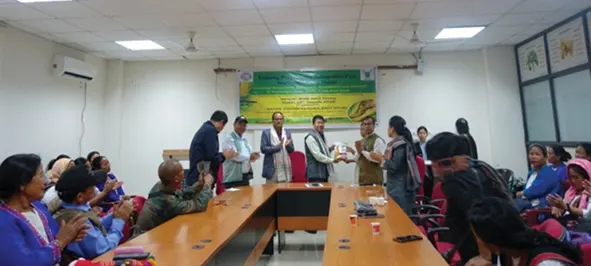
PASIGHAT, 28 Mar: A training programme on integrated pest management in maize, along with a seed distribution programme was organised by the East Siang Krishi Vigyan Kendra (KVK) at Telam village in the district on Friday.
A total of 78 farmers participated in it.
College of Horticulture and Forestry (CHF) Dean Prof L Wangchu in his address advised the farmers to adopt scientific maize cultivation practices for better returns, and to follow integrated pest management for effective control of insect pests and diseases.
He also stressed the need for formation of farmers-producers organisations for marketing agricultural produce in bulk.
Emphasising the adoption of integrated pest management technology in maize, he highlighted the issue of fall armyworm (FAW) infestation in maize.
East Siang KVK Head Dr Brijendra Singh spoke about the activities of the KVK for the upliftment of the farming community, and highlighted the present scenario of maize cultivation in the district.
NRM Department Head Dr P Debnath delivered a lecture on scientific maize cultivation practices. He emphasised on proper nutrient management in maize, as it is a high nutrient-demanding crop.
Plant protection scientist Dr Toge Riba delivered a talk on integrated pest management in maize, with special emphasis on the management of FAW. He also shared information about CHF-produced Beauveria bassiana, a biopesticide which is effective against fall armyworm and other lepidopteran insect pests in maize.
He further discussed the current FAW infestation in the district during the present cropping season.
Agricultural engineering expert Dr RK Salam shared information on mechanisation of maize cultivation and delivered videos presentation on the use of advanced machinery in maize farming.
Dr Th Eloni Vida spoke on post-harvest management and value addition of maize, while, veterinary and animal husbandry scientist Dr Neeta Lonjam highlighted the importance of maize as a major component of feed and fodder for livestock,and shared information on homemade feed composition for animals and poultry.
Two quintals of hybrid maize seeds were distributed to the farmers during the programme.