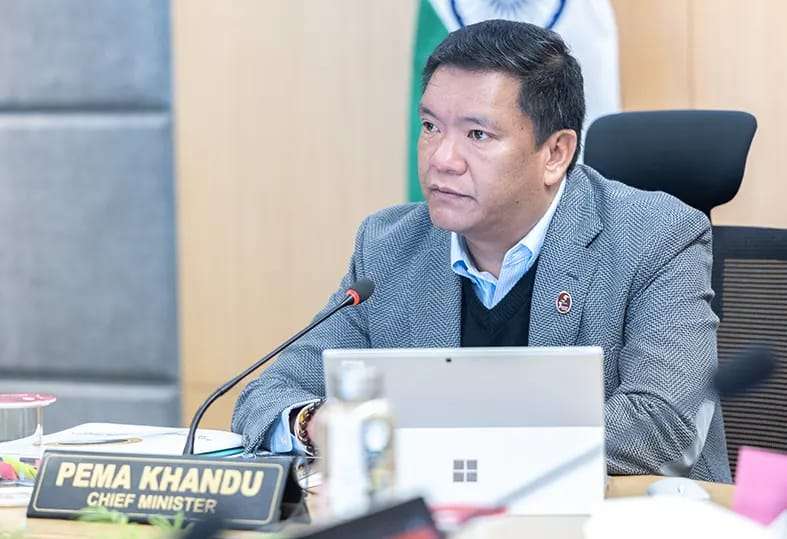
NEW DELHI, 6 Apr: The Supreme Court on Monday directed the CBI to register within two weeks a preliminary enquiry into allegations of preferential allotment of contracts for public works in Arunachal Pradesh to firms allegedly owned or related to the family members of Chief Minister Pema Khandu.
Observing that the state and its instrumentalities cannot confer benefits according to the “whims of any political or administrative functionary,” the apex court said it is a fit case where an “independent investigation” is necessary.
A bench headed by Justice Vikram Nath said where a case concerns the integrity of public procurement and involves allegations of conflict of interest at the highest levels, an investigation must not only be fair but also must appear fair.
“Accordingly, we deem it appropriate that CBI shall register a preliminary enquiry forthwith and shall conduct a time-bound investigation into the award and execution of the public works contracts and work orders which form the subject matter of this writ petition and the affidavits filed in these proceedings,” the bench, also comprising Justices Sandeep Mehta and NV Anjaria, said.
During the hearing in the matter, the apex court was told that government contracts and work orders worth around Rs 1,270 crore were awarded in the last 10 years in Arunachal to four firms related to the family members of Khandu.
In its verdict, the bench said the preliminary enquiry and consequential investigation, if any, shall cover the award and execution of public works contracts and work orders in Arunachal from 1 January, 2015 to 31 December, 2025, including the works and compilations placed on record in the proceedings before it.
The bench delivered its verdict on a plea filed by NGOs Save Mon Region Federation and Voluntary Arunachal Sena, seeking a CBI or SIT probe into the matter.
“The record discloses repeated resort to non-tender methods in relation to public works, repeated absence of recorded reasons explaining why competition was dispensed with, and repeated non-production of vouchers and tender-related documentation in relation to projects of substantial value,” the bench said.
It said such circumstances raise legitimate concerns not merely of administrative irregularity but of “possible abuse of public office,” manipulation of procurement processes, and concealment or destruction of official records – matters which require probe by an independent agency vested with statutory powers of criminal investigation.
The bench noted that the petitioners have alleged that a significant cluster of such awards has accrued to respondent numbers four to six (Pema Khandu, Rinchin Drema and Tsering Tashi) or to firms and individuals related to them, raising a serious question of conflict of interest and abuse of public office.
It said these are not matters that can be left to be answered by broad affidavits or by statistical summaries.
“They require a structured investigation into the decision-making process, the manner of selection of contractors, the justification for deviations from tender-based procurement, and the integrity and custody of public records,” the bench said.
Pema Khandu was made a party respondent in the PIL. His father Dorjee Khandu’s second wife Rinchin Drema and his nephew Tsering Tashi were also made parties to the case.
In its verdict, the bench said the credibility of the process is as important as its eventual outcome. It said the investigation shall include examination of the procurement process, the reasons and approvals for dispensing with tender, identity of beneficial owners of the contractor entities and the like, and any other connected matter necessary to ascertain whether any illegality or cognisable offence is disclosed.
It said the CBI shall, in particular, examine awards made to respondents number four to six and to firms or individuals related to them, and shall examine the procurement process, reasons and approvals for dispensing with open tender, compliance with applicable statutory requirements, availability and custody of records, flow of funds and payments, and such other connected aspects.
“The CBI shall not be precluded from examining transactions outside the above period to the limited extent necessary for tracing beneficial ownership, related-party links, fund flows or other connected circumstances that bear upon the transactions within the above period,” it said.
The bench said Arunachal and all its departments, authorities and instrumentalities concerned shall cooperate fully with the CBI.
It said they shall within four weeks make available relevant records, including sanction orders, administrative approvals, technical sanctions, tenders, comparative statements, tender committee records, work orders and all electronic data relating to e-procurement and payments.
The bench directed the chief secretary of Arunachal to designate within a week a nodal officer for coordination with the CBI.
“The State of Arunachal Pradesh shall ensure that no record, physical or electronic, relevant to the subject matter of the enquiry and investigation is destroyed, altered or rendered inaccessible,” the bench said.
It said the chief secretary shall issue necessary directions to all departments concerned within a week to secure preservation of records and electronic logs.
It directed the CBI to file a status report within 16 weeks.
“We clarify that the observations made in this judgment are for the purposes of deciding whether an independent investigation is warranted,” it said. (PTI)