[ Prem Chetry ]
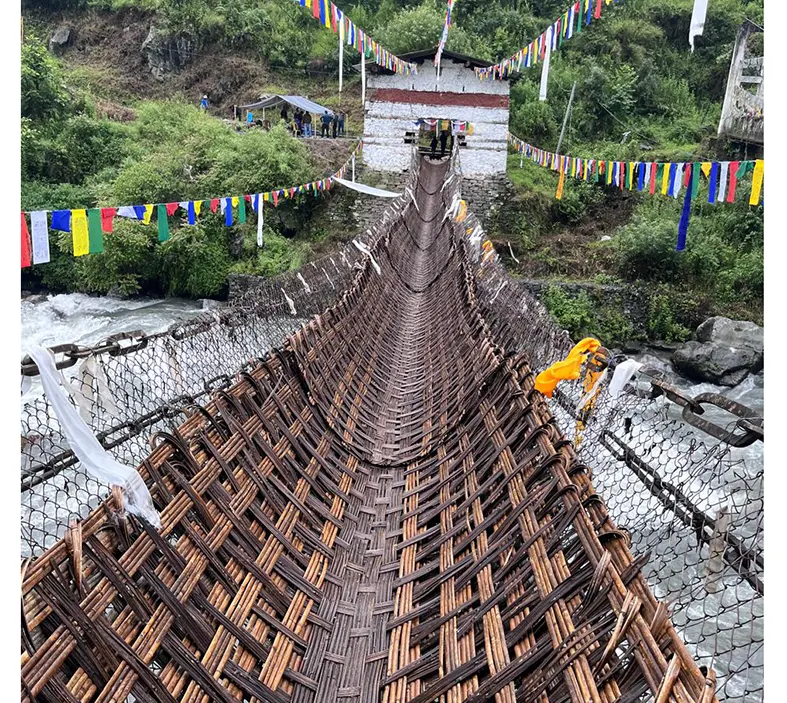
TAWANG, 12 Dec: Standing for more than five centuries over the roaring Tawang Chu river, the historic Chakzam bridge continues to embody the ingenuity of its creator, Thangtong Gyalpo, the 15th-century Tibetan engineer-saint famed for constructing over 100 iron-chain suspension bridges across the Himalayas.
Yet what keeps this remarkable structure alive today is not ancient engineering alone – it is the unwavering dedication of the residents of Mukto, Gyomkelleng, and Mirba villages in Tawang district.
The Chakzam bridge is a heritage deserving of the UNESCO’s attention. The people of Tawang and West Kameng districts revere the bridge not merely as an architectural marvel but as a spiritual and cultural symbol woven deeply into community identity. The villagers’ longstanding custodianship, carried out year after year without external assistance, highlights the kind of living heritage that the UNESCO seeks to protect.
The Chakzam bridge is a heritage too precious to lose not only for the people of Mukto, Gyomkelleng, and Mirba, who have become its modern-day guardians, but also for the state and the nation.
Community efforts of Mukto, Gyomkelleng, and Mirba villages reinforce the case for UNESCO recognition.
Every year, the three custodian villages unite to carry out annual restoration of the Chakzam bridge, relying entirely on community labour and indigenous knowledge passed through generations.
The villagers replace bamboo mats and other traditional components annually, demonstrating a living heritage practice that aligns closely with the UNESCO’s criteria of authenticity, continuity, and community stewardship.
Their commitment is not confined to structural repairs alone. Seasonally, the volunteers also conduct cleanliness drives around the sacred site, protecting the natural and spiritual ambience that has defined the bridge for centuries.
The three villages exhibit responsible tourism with a call for respect and restraint. As tourists and visitors gradually increase, the custodian communities have also taken the responsibility of educating visitors. They urge tourists and visitors not to litter in or around the historic site, and not to tie prayer flags on the bridge, as the accumulating fabric accelerates the decay of bamboo mats. Instead, visitors are encouraged to tie prayer flags from one kakaling (entrance gate) to the other, preserving both the spiritual symbolism and the structural integrity of the bridge.
Despite their tireless self-funded efforts, the villagers stress that safeguarding such a culturally significant structure requires more robust support. They are appealing to the state government and the Ministry of Tourism to develop essential infrastructure for visitors, including a cafeteria, eco-friendly cottages for tourists, researchers, and historians, and basic amenities to enhance visitors’ experience and support responsible heritage tourism.
According to the villagers, such infrastructure is crucial not for commercialisation, but for ensuring that the Chakzam bridge is preserved, documented, and shared with the world in a sustainable manner.
The bridge stands today because its people stand with it, and their collective stewardship strengthens the argument that this centuries-old marvel deserves recognition on the UNESCO’s tentative list.