[ Dawa Ruku ]
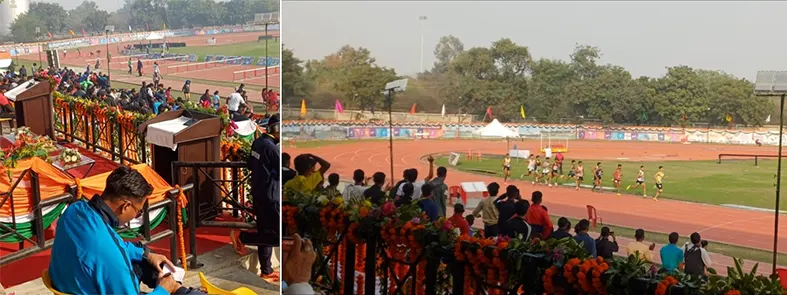
I am currently in Lucknow for the 69th National School Games Athletics (Under-17) Championship – 2025, where 36 states and union territories from across the country have gathered. I am here representing Arunachal as a coach. To be completely honest, I am a football coach, not an athletics coach. Football and athletics are worlds apart – different training methods, different techniques, different demands on the body and mind. Sitting in the stadium and watching elite young athletes from other states, this reality struck me deeply. From this single fact, one can already imagine where our athletes might stand in the final rankings.
As I sat quietly in the stadium, watching race after race, jump after jump, I felt something I had never felt before. It was not fear, not anger – it was shame mixed with helplessness. In our local language, it is enyiang. I kept asking myself again and again: Is this right? Is this fair to our children? Is this the best we can do for them?
This article is about the present condition of athletics in Arunachal and the true meaning of sportsmanship. Why does our state perform so poorly at national-level competitions? Why do we return home with so few medals from the National School Games? Who is responsible for this painful reality -the players who try their best, the parents who dream for their children, the coaches who struggle with limitations, or the higher authorities who make decisions from faraway offices?
Is the problem the lack of infrastructure, the lack of proper equipment, or the absence of trained and specialised coaches? These questions do not have simple answers, but they must be asked honestly if we truly care about the future of sports in our state.
In my opinion, school-level sports are the roots of every sporting journey. School games are not just competitions; they are the birthplace of confidence, discipline, and dreams. Schools have the greatest responsibility in shaping young athletes because they see children every day. They can identify talent at the earliest stage. For this very purpose, we have physical education teachers (PETs) – professionals trained to recognise ability, nurture potential, and guide students toward excellence.
The Government of Arunachal Pradesh has appointed many PETs over the years. Many have served sincerely and are now retired. Yet, despite their presence, our state continues to remain weak in almost every sporting discipline. This truth hurts, but it cannot be ignored. We must ask ourselves: Where did we go wrong?
One painful reality is that many PETs are still assigned to teach academic subjects such as mathematics, science, English, and Hindi. Many of them come from other states and are capable teachers, but when a PET is taken away from the playground and placed inside a classroom, sports loses its guardian.
This reflects a deeper misunderstanding of the importance and role of physical education. When those meant to build athletes are not allowed to do their job, how can we expect sporting excellence?
At this national championship, our team consists of six boys and six girls, accompanied by one female coach who does not come from a sports background. This is not written to blame anyone; it is written to show the reality on the ground. Despite all these limitations, our athletes are standing on the same track, breathing the same air, and competing with the best in the country. That itself requires courage.
This opportunity has been made possible because of the tireless efforts of Sports ADSE Takam Pate and sports coordinator Suresh Raja, both from the Directorate of Secondary Education, Itanagar. They have worked day and night, often within very short notice, to ensure that our athletes could at least get a platform. Without such support, our presence here would not have been possible.
Without participation, we can never understand our weaknesses. Without exposure, our athletes can never measure their capacity. Therefore, on behalf of all 12 athletes, I express my heartfelt gratitude to Takam Pate for giving these children a chance – not just to compete, but to learn, to observe, to feel the intensity of national-level competition. For many of them, this experience will remain in their hearts forever. It is here that they truly understand what competition means, what sacrifice means, and what true sportsmanship feels like.
This moment, painful as it is, can become a turning point – a turning point where our athletes realise their potential, where coaches reflect on preparation, and where authorities rethink priorities.
I conclude this article with one honest belief: it is never too late to begin. If we listen to our athletes, respect the role of PETs, invest sincerely in school sports, and work together with responsibility and compassion, Arunachal can rise. The road will be difficult, but every strong journey begins with truth, courage, and the willingness to change. (The contributor is a football coach)