[ Prem Chetry ]
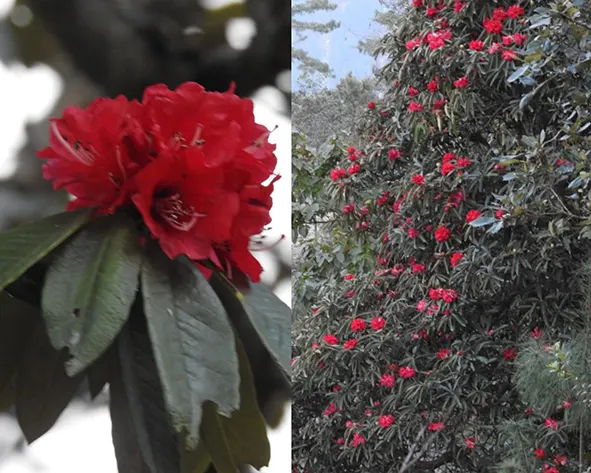
BOMDILA, 31 Jan: An unusually early flowering of rhododendron arboreum has been recorded at the Eaglenest Wildlife Sanctuary (EWS), raising concerns among forest officials and environmental experts about changing climatic patterns in the eastern Himalayas.
The first bloom was observed on 25 January by Range Forest Officer Yachang Kani – nearly a month earlier than the species’ normal flowering season, which typically begins in late February and extends through April.
“While these crimson blooms traditionally signal the transition to spring, their appearance in late January is a significant phenological event, indicating a phenological shift,” he said.
He cautioned that this is a matter of concern, as rhododendron arboreum is a climate indicator species.
Generally, peak flowering occurs between late February and April. A January bloom suggests a response to unseasonably high mean temperatures or a shift in the local microclimate, potentially linked to broader climatic warming.
He further stated that this represents a trophic mismatch.
“It is not just about aesthetics; it is about timing.
Many high-altitude pollinators, such as the fire-tailed sunbird, rely on this nectar. If the flowers bloom and wither before the birds migrate or insects emerge, it creates a ‘trophic mismatch,’ threatening the survival of both the plants and the pollinators.”
The far-reaching consequences can also disrupt water cycles. In the eastern Himalayas, rhododendrons act as crucial ‘cloud catchers’, helping regulate soil moisture. Early flowering can alter the tree’s water-use efficiency during the dry winter months.
“While the bloom is a visual triumph, we must view it as a silent ‘bio-alarm’ regarding the changing rhythms of our mountain ecosystems,” he remarked.
Meanwhile, another unusual event – the early emergence of cicadas (cicadoidea) in December 2025 – was also reported from Bomdila, Tawang, and several other high-altitude locations – a period when cicadas are typically inactive due to cold temperatures.
Cicadas are highly sensitive to temperature changes. Their emergence in winter implies warmer conditions, which could disrupt their life cycle. Such disruption can have cascading effects on dependent species, including birds and reptiles.