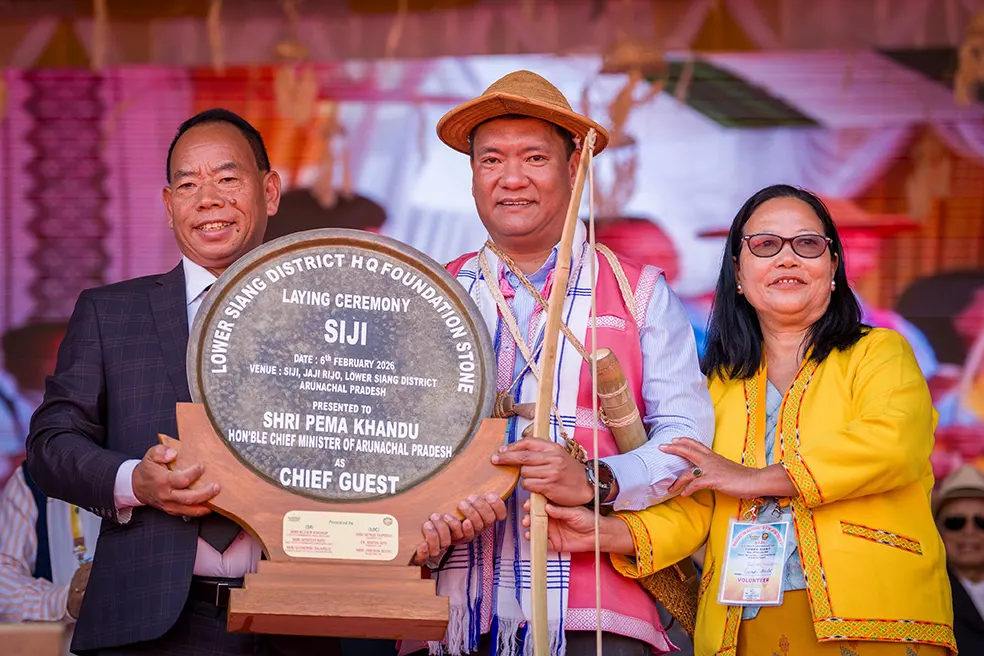
SIJI, 6 Feb: Chief Minister Pema Khandu on Friday laid the foundation stone of the permanent headquarters of Lower Siang district in Siji, describing the occasion as a historic milestone after more than a decade-long journey marked by administrative and developmental challenges.
Addressing a large public gathering in the presence of ministers, MLAs, senior officers, panchayat leaders and community representatives, the chief minister recalled that Lower Siang district was created in 2013, but could not progress as expected due to prolonged issues related to district boundaries, finalisation of the headquarters, and infrastructure delays.
“From 2013 till today, nearly 13 years have passed. Unfortunately, Lower Siang faced more problems than development during this period. Today’s programme marks a turning point,” he said.
The chief minister appreciated the role of the local area committee and elected representatives “for placing the historical background and chronology of the district headquarters issue on record,” stating that the people themselves are best aware of the journey and the challenges faced.
He expressed gratitude to the local land donors who voluntarily parted with their agricultural land for the development of the district headquarters, calling it a major contribution towards the future of Lower Siang.
Highlighting disparities in development, Khandu noted that several districts created later than Lower Siang have progressed faster, with their headquarters and administrative infrastructure already functional. He cited examples from other districts to underline the need for Lower Siang to move forward without further internal delays.
Appealing for unity, the CM urged the people to move beyond internal issues related to the district headquarters.
“We must stop creating issues among ourselves. Now is the time to work together and take Lower Siang forward,” he said.
Referring to the permanent headquarters issue, he reiterated that the decision had already been finalised through constitutional and legislative processes in 2022, and emphasised that coordination and collective effort are now required for development.
The CM assured that road connectivity remains the top priority, particularly the proposed Siji to Koyu road via Sikirima (in Nari-Koyu assembly segment), stating that alignment and DPR exercises have already been completed. He assured that the project would be taken up on priority.
Khandu also stressed the importance of adhering strictly to the approved master plan for Siji headquarters, cautioning against unplanned construction. He assured that more projects would be sanctioned in the coming years to complete essential district-level infrastructure.
Touching upon governance and grassroots empowerment, Khandu emphasised the crucial role of panchayati raj institutions, urging newly elected panchayat leaders to actively study government policies and schemes instead of relying solely on elected representatives. He highlighted recent training programmes organised for panchayat members, and reiterated the government’s commitment to strengthening local self-governance without political interference.
The chief minister also spoke about the recent union budget provisions, particularly schemes focused on rural employment, infrastructure, livelihoods, women empowerment and youth development, and urged local leaders to ensure effective implementation at the village level.
Reaffirming the state government’s commitment, Khandu said that Arunachal Pradesh is witnessing large-scale infrastructure development across all regions, and assured that Lower Siang would receive its due share in the coming years.
Calling upon all sections of society to adopt a shared vision, he said, “Development is a continuous process. What we need is unity, planning, quality execution and strong political will.”
As far as Sikirima (the proposed headquarters by a section of the people) is concerned, Khandu assured that he would soon visit the place and consider what important and major infrastructure could be created for its development. He insisted that once the Siji to Koyu road (via Sikirima) is completed, communication between areas falling under the Nari-Koyu assembly segment and Siji would be resolved. He further assured that the interstate-boundary issue along the Arunachal-Assam boundary, particularly with regard to the Ramle Banggo area, would be taken up on priority.
It may be noted that the decision to establish Siji as the permanent headquarters of Lower Siang district follows a long administrative and consultative process dating back to the creation of the district under the Arunachal Pradesh (Reorganisation of Districts) Act, 2013.
The demand for the creation of Lower Siang district was initially raised by the people of Nari-Koyu, with subsequent participation from stakeholders from the Likabali area. Over the years, various representations were submitted, suggesting different locations for the district headquarters, including proposals for Garu and Sikirima, with temporary headquarters at Likabali. These submissions were examined at multiple levels by the state government.
To address the prolonged impasse, the government constituted several committees from time to time, including high-power committees, committees of legislators, a group of ministers and, later, a three-member committee constituted in 2021 following a cabinet decision. Based on detailed examination, consultations and feasibility assessment, the state cabinet, in its meeting held on 23 February, 2022, approved Siji as the permanent headquarters of Lower Siang district.
The decision was subsequently endorsed by the Arunachal Pradesh Legislative Assembly through an amendment to the district reorganisation law.
The headquarters site in Siji covers more than 322 hectares of land, voluntarily donated by local landowners. The location offers adequate plain land for systematic and future-oriented development, assured water availability from perennial sources, and proximity to the Likabali-Aalo national highway, ensuring long-term connectivity and scope for planned expansion.
With regard to environmental and legal aspects, the state government has followed all statutory procedures. Forest diversion proposals were submitted through the Parivesh portal of the union environment, forest and climate change ministry, and in-principle forest clearance has been accorded. The state government has deposited the required amount towards afforestation and net present value, with afforestation planned over double the diverted forest area.
In matters relating to litigation, the National Green Tribunal, while issuing interim directions in earlier cases, has also observed that the establishment of a district headquarters falls within the administrative domain of the state government, subject to compliance with statutory clearances. Another application challenging the administrative decision was dismissed by the tribunal, terming it misconceived.
The chief minister reiterated that development at the district headquarters would not be at the cost of other areas of Lower Siang, and that balanced, inclusive development across all circles and villages of the district remains a priority.
During the programme, foundation stones were laid for nine projects, and seven completed projects were inaugurated, involving a cumulative investment of over several crores of rupees.
These include inauguration of 12 Type-II residential quarters for fire and emergency staff, the Kardu Taipodia Triple Court Indoor Badminton Stadium, a police station, a guard room, a sentry post and garage, one-stop centre, augmentation of drinking water supply for Likabali, drinking water supply in Gensi, and water supply project in Sile.
Foundations were laid for a mini-secretariat, an RCC bridge over the Siji river, the road from the Likabali-Aalo highway to Siji, a Government Secondary School in Dipa, accommodation for officers and government staff, rest house for patients and shelterless, a fire station, Type-V staff quarters and a new police station in Pale. (CM’s PR Cell)