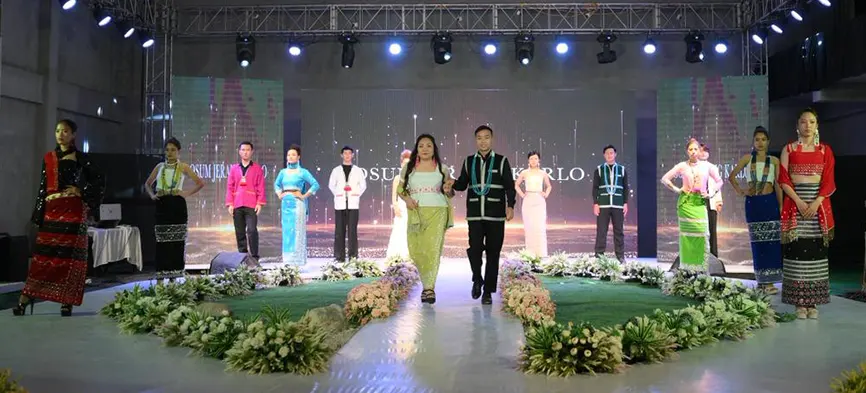
NAHARLAGUN, 22 Mar: The ‘Arunachal Fashion Week 2026 – The Artisans’ Movement’ concluded on a high note at Interior Park here on Saturday, marking the culmination of an eight-day celebration of indigenous textiles, creative enterprise, and cultural identity.
The grand finale, held as the ‘Cultural Heritage Day and Awards Night’, was attended by Textile and Handicrafts Minister Nyato Dukam and Doimukh MLA Nabam Vivek, among others.
The event brought together designers, weavers, artisans, models, creative professionals and industry stakeholders, celebrating five years of the Artisans’ Movement, which has steadily evolved into a structured platform connecting traditional craftsmanship with contemporary design and market opportunities.
Over the course of the week, the Arunachal Fashion Week showcased runway presentations, live performances and a large-scale multi-floor exhibition featuring handloom collections, designer wear, jewellery, accessories, home décor, furniture, and artisan craft displays, creating a vibrant public interface between creators and consumers.
The closing ceremony recognised excellence across categories, with winners including Millo Antu (Arunachal’s next top model – Miss 2026), Tapang Taba (Arunachal’s next top model – Mr 2026), OsumJerang Karlo (Arunachal’s next top fashion designer), Jiyi Ete (Arunachal’s next top weaver), Zenith Khonjuju (Arunachal’s next top emerging fashion designer), Sampi Miri (AFW showstopper of the year), Techi Tana Tara (AFW most popular model of the year), Anna Taying Kamdak (AFW most fashionable guest of the year), and Millo Kari Kago (AFW outstanding buyer of the year.
Addressing the gathering, Dukam said, “Today I feel proud to serve as the minister for textile & handicrafts after witnessing the talent and creativity of our designers on this platform. What we are building here is not just a fashion event, but a larger movement – one that preserves our culture, empowers our youths, and positions Arunachal Pradesh as a strong and confident voice in India’s indigenous and sustainable fashion ecosystem.”
“With strong support from the chief minister and the department, we are strengthening market linkages, promoting indigenous textiles and creating opportunities for our youths,” he said.
Dukam added: “Through platforms like Arunachal Fashion Week, we are not just organising shows; we are preserving our culture, our traditions and our heritage. This is a collective ecosystem where artisans, designers, youths and creative professionals come together to build something meaningful.”
Arunachal is steadily strengthening its textile economy, producing nearly 69 metric tonnes of eri, muga and mulberry silk annually and supporting over 34,000 livelihoods across nearly 500 villages, with a proposed Rs 25 crore push towards sericulture and youth-focused skill development initiatives aimed at further expanding the sector.
MLA Vivek in his address said, “What we have witnessed clearly shows that our designers are second to none – the creativity, fabric and presentation are truly world-class. Fashion is a reflection of our identity, and it is encouraging to see our local designers and artisans doing such outstanding work.
This is a strong beginning for Arunachal Pradesh, and I am confident that with such efforts, our designers and artisans will continue to achieve greater heights.”
Textile and Handicrafts Director Dorjee Phuntso commended the vision behind Arunachal Fashion Week and acknowledged Yana Ngoba Chakpu for conceptualising and nurturing the platform. He noted that, over the past five years, the Artisans’ Movement has evolved into a structured ecosystem, connecting designers, weavers and creative professionals, while the department continues to strengthen the sector through skill development, capacity building and enhanced market linkages.
Yana Ngoba Chakpu, founder and chief executive officer of Northeast India Fashion Week – The Artisans’ Movement, said, “Arunachal Fashion Week is the beginning of a larger journey. We will now also move towards Northeast India Fashion Week. Our focus is on taking this platform across different states of the region and amplifying the textiles, weaving practices and stories of the Northeast on bigger national and global platforms. This is about building a connected ecosystem where our artisans, designers and creative professionals can grow together and represent the region with confidence.”
Chief operating officer Meena Noshi noted: “While Arunachal Fashion Week may appear to be an eight-day celebration, the truth is, it has taken us more than a year of dedication, hard work, and belief to bring this vision to life. From our first step during Nyokum last year in Pakke-Kessang to this very moment, this platform has grown with the support of so many people. As we move forward, our vision is clear – to build a strong, structured fashion industry in Arunachal Pradesh, and to establish our state as a proud indigenous fashion hub of India, and the world.”
As Arunachal Fashion Week 2026 drew to a close, it reinforced the state’s growing position at the intersection of culture, creativity and commerce, where indigenous textiles are not only preserved, but professionally presented, economically empowered and strategically positioned within India’s evolving creative economy, a release from the organisers stated.