NEW DELHI, 16 Apr: A fact-finding team, which had visited Siang and Upper Siang districts of from 20-24 February to understand the concerns and perspectives of the local communities regarding the proposed Siang Upper Multipurpose Project (SUMP), has, along with local communities, demanded immediate reconsideration of the project and ensuring free, prior and informed consent (FPIC) of the affected communities.
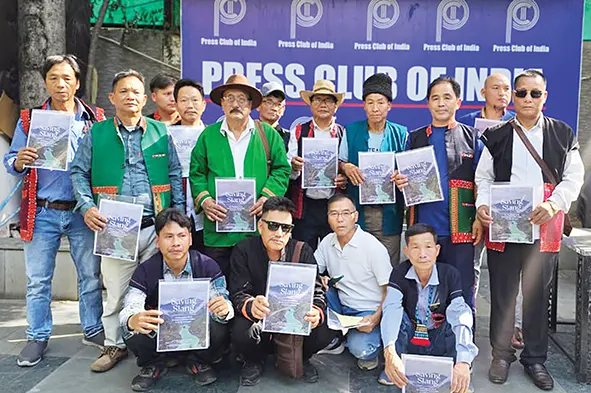
Addressing the media at the Press Club of India in New Delhi on Thursday in favour of “the struggle for cultural survival and self-determination in Arunachal Pradesh,” the team also demanded that the authorities concerned ensure the safety of the leaders wrongfully incarcerated by law, and withdrawal of cases against all.
“A general FIR of 400 has been registered against the villagers and leading members and organisers, namely advocate Ebo Mili, Bhanu Tatak, executive team of AdiSU (Adi Students’ Union), led by its former president Jirboh Jamoh, face court cases till date. A total of nine gaon buras have been suspended and terminated for their stand against the said dam,” the team said in a release.
It demanded initiation of a transparent and democratic dialogue process, independent environmental and social impact assessment, and exploration of alternative and sustainable development models.
The fact-find team comprised Sandeep Pandey, Gunjan Singh, Niya Tapo, Biju Borbaruah and Ramuni Burhagohain. Its visit to Siang and Upper Siang highlights growing resistance among indigenous communities, who view the project as a serious threat to their land, livelihoods, and cultural identity. The initiative was undertaken on behalf of the Green Party (associated with the Socialist Party, India), in collaboration with the Siang Indigenous Farmers’ Forum (SIFF) and its youth wing.
The team said that, “with an estimated capacity of around 11,200 MW, the proposed project is among the largest hydropower projects planned in India. Field observations indicate that more than 20 villages may face complete submergence, while over 50 villages could be directly or indirectly affected. This raises the possibility of large-scale displacement, loss of agricultural land, and disruption of traditional livelihoods in the region.”
For the indigenous communities of the Siang valley, particularly the Adi tribe, the river is revered as ‘Mother Siang’ and forms the foundation of their cultural, spiritual, and economic life. The proposed dam is therefore perceived not merely as a development initiative, but as a direct threat to their identity, heritage, and relationship with nature.
The team stated that local communities, under the leadership of the SIFF, had expressed strong opposition to the project since the formation of the SIFF in 2012. Before the formation of the SIFF, protests had long been held under the banner of the Siang Bachao Andolan ever since the Brahmaputra Board proposed a dam in Siang in the 1980s. The protest against the Siang dam has reached it third generation and spans over 40 years, it stated.
The fact-finding team said that several village councils (kebangs) have formally rejected the project based on the principle of FPIC. Protest slogans such as ‘No dam, no survey’ and ‘Save Siang’ reflect the depth of concern and resistance in the region, it said.
The team also observed that project-related activities have begun at the preliminary stage itself, including corporate social responsibility (CSR) initiatives and special development packages by the NHPC being executed by government departments, “infiltrating the administration.”
“As per CSR guidelines, CSR or outreach activities should not be executed by government departments. Locals have protested against this unconstitutional allocation of CSR and refuse to accept it, demanding that the government departments use departmental funds allocated by government and not the NHPC. Local residents have raised concerns over the lack of transparency and have questioned whether such initiatives are being used to influence consent and create divisions within communities,” it said.
More than 1,000 paramilitary personnel have been deployed in the villages and the headquarters of Siang, Upper Siang and East Siang districts since December 2024 to quash the protests, the team said.
The team said that “the mentioned police cases and wrong incarceration of people, and curtailing of indigenous tribal voices is a harrowing realisation and disgraceful for democratic fabric of the nation. These events calls for serious consideration of the Siang dam and how it is being brutally implemented needs nationwide attention.”
Furthermore, the project is located in a highly earthquake-prone area (Seismic Zone V), raising serious concerns about safety and long-term risks. Additionally, the fragile ecology and rich biodiversity of the eastern Himalayas are at risk due to large-scale construction and submergence, the team said.
“This issue is not merely about infrastructure development, but about indigenous rights, environmental justice, and democratic accountability. It is imperative that the voices of the people of the Siang valley are heard and respected,” the team said.