Book Review
[Dr. Bikash Mepo]
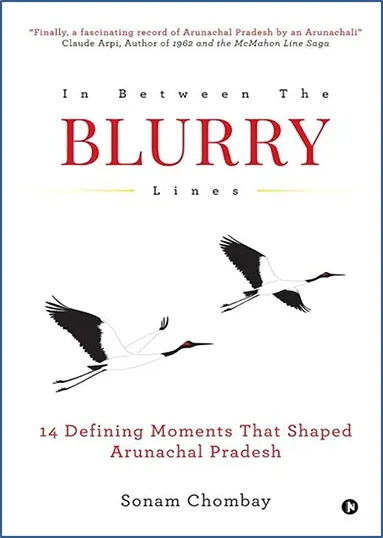
In Sonam Chombay’s In Between the Blurry Lines: 14 Defining Moments That Shaped Arunachal Pradesh, the author writes with the keen lens of a bureaucrat. The book does what few outsider narratives have managed: it renders the “terra incognita” intimately knowable without stripping it of its agency. As Claude Arpi aptly observes, it is: “Finally, a fascinating record of Arunachal Pradesh by an Arunachali.”
Chombay sifts through 151 years of written records and deeper oral traditions to curate 14 turning events from the Bengal Eastern Frontier Regulation of 1873 to the seismic shifts of the 1950 Assam-Tibet earthquake, the Anglo-Abor War of 1911, the philosophical interventions of Verrier Elwin, and beyond. These are not isolated incidents but multifaceted in a complex collage where colonial ambition, tribal resilience, and modern nation-building intertwine.
The title itself is poetic and pointed: it acknowledges the deliberate vagueness with which empires and even national histories have treated the region Inner Line, Outer Line, McMahon Line boundaries that were as much as fictions as instruments of control.
The opening chapter on the Inner and Outer Lines stands as one of the book’s strongest. Chombay traces the 1873 Regulation not merely as a bureaucratic tool to curb tribal raids and safeguard British tea, coal, and rubber interests, but as a “dual-purpose” mechanism: ostensibly protective of indigenous ways, yet strategically isolating commercial enclaves. He writes with nuance about its unintended blessings preservation of tribal land rights, cultural practices (such as the Apatanis’ efficient paddy-cum-fish cultivation and democratic village councils), and demographic integrity while candidly noting the costs: developmental lag, limited integration, and persistent disparities. The Regulation ripples continue today, including the exemption of Inner Line Permit areas from the Citizenship Amendment Act (2019), showing how colonial scaffolding still shields fragile ethnic balances. The discussion of Verrier Elwin’s “Philosophy for NEFA” in the elegant imperative of “hastening slowly” brings a thoughtful counterpoint to assimilationist urges, rooted in respect for tribal autonomy and gradual evolution. In Chombay’s telling, the tribes were never passive; they navigated, resisted, and adapted within these blurry confines.
Chombay shows how these strategic and political decisions that drew the Inner, Outer, and McMahon Lines became defining moments that left indelible marks on the region’s social, political, and economic landscape. These lines, born out of the British colonial desire to protect their frontiers, were formalized most significantly through the 1914 Simla Agreement that established the McMahon Line, separating Arunachal from the lands to its north.
Culturally, these lines preserved the natural insularity of the tribes, protecting their rich cultural fabric from being overwhelmed by outside influences. Yet, as far as economic development was concerned, the restrictions meant that Arunachal Pradesh remained backward and peripheral to the rest of India. “Staking economic development for cultural authenticity became a trade-off. A smart deal, when we look back now!” writes Chombay.
Geo-politically, the lines have remained a focus of constant contestation and strife, particularly the McMahon Line, which China has lately refused to accept. Arunachal’s security is still affected by this dispute, as residents’ identities and modes of governance are wrongly being questioned. These ‘lines of cut-off’ also imposed a cultural separation between the tribes and mainland India. While the boundaries helped maintain the distinctive cultural identities, languages, and customs of Arunachal’s tribes, their prolonged isolation hampered social development and integration with broader Indian. Chombay poignantly captures this tussle: the historical lines around Arunachal Pradesh have affected every facet of life protecting its demographic and cultural homogeneity, but also restricting its economic and social development.
Arunachal Pradesh today stands at a crucial crossroads, where the push for modernity is putting traditional values to the test. In the concluding section of his book, Sonam Chombay identifies several pressing issues facing the state.
On governance, he highlights a persistent struggle for stability. Unlike other states, Arunachal does not have its own cadre of officers and continues to rely on the AGMUT cadre, which succeeded the old Indian Frontier Administrative Service (IFAS). While these officers are capable and dedicated, their short tenures in the state’s extremely challenging Himalayan terrain make it difficult to ensure sustained commitment and long-term planning. Chombay contrasts this with the IFAS officers of the 1950s, who were specially trained for frontier regions and approached their roles with genuine empathy and understanding of local realities. On land resources and equity, Chombay notes that land in Arunachal is far more than mere property it is deeply tied to community identity and spiritual traditions. The absence of formal land records and detailed cadastral surveys has given rise to worrying trends of elite capture, where individuals in positions of power are increasingly claiming large tracts of community land, including rivers and mountains.
Electoral politics suffers from a vicious cycle of cash for votes. With a sparse population resulting in small constituencies averaging only 5,000 to 10,000 voters, every vote carries enormous weight. This often compels candidates to spend heavily on cash, contracts, and jobs to secure victory. Quoting prominent journalist Ajum, Chombay drives home the point: “If the candidates have to spend so heavily to win an election, how can we expect them to carry out development work?”
Arunachal Pradesh also stands on the brink of a hydropower boom, with the potential to generate around 19 GW of renewable energy in the coming years. This surge could transform the state into one of India’s wealthiest per capita. However, Chombay raises important questions about how this new wealth can be distributed equitably, how it should be managed responsibly, and how the next generation can be prepared through financial literacy and a strong commitment to sustainable practices.
Despite these formidable challenges, Chombay envisions a resilient, self-reliant Arunachal Pradesh that contributes meaningfully to India’s growth while remaining true to its unique identity. He believes development should not be seen as a threat to culture, but rather as a way to celebrate and sustain it where progress and tradition walk hand in hand.
Stylistically, Chombay’s writing is both accessible and layered. He skillfully blends rigorous archival research with narrative warmth and personal reflection. He avoids both dry academic detachment and overly romantic exoticism. The book often reads like a thoughtful gazetteer infused with memoir-like insights a beginner’s guide to Arunachal’s mystic frontiers that never talks down to the reader.
In a literary tradition where borderlands are too often rendered through external gazes Edward Said’s critique of Orientalist constructs lingers here Chombay writes from within the frame. He resemble Chinua Achebe’s insistence on telling one’s own story: “Until the lions have their own historians, the history of the hunt will always glorify the hunter.” The book’s greatest strength lies in its humanistic core. It refuses to reduce Arunachal to a strategic buffer or a 1962 footnote. Instead, it portrays a people who, in the words of the text’s spirit, “navigated these moments to define themselves as ‘Arunachalis’ rather than just subjects of a frontier administration.” (The contributor is an independent Scholar)